Quick Answer
At 37 weeks, your baby is early term (~48cm, 2.9 kg). This is a major milestone — your baby is no longer considered premature. Toenails have reached the toe ends. Baby may have dropped into your pelvis (called lightening or engagement). You could go into labor any day now, though most first-time mothers deliver between 39-41 weeks. From this point, you need to know the signs of labor and when to go to the hospital.
Baby Development at Week 37
Your baby is early term — ready to be born, though a couple more weeks is ideal:
- Toenails reach toe ends — fingernails may extend past fingertips
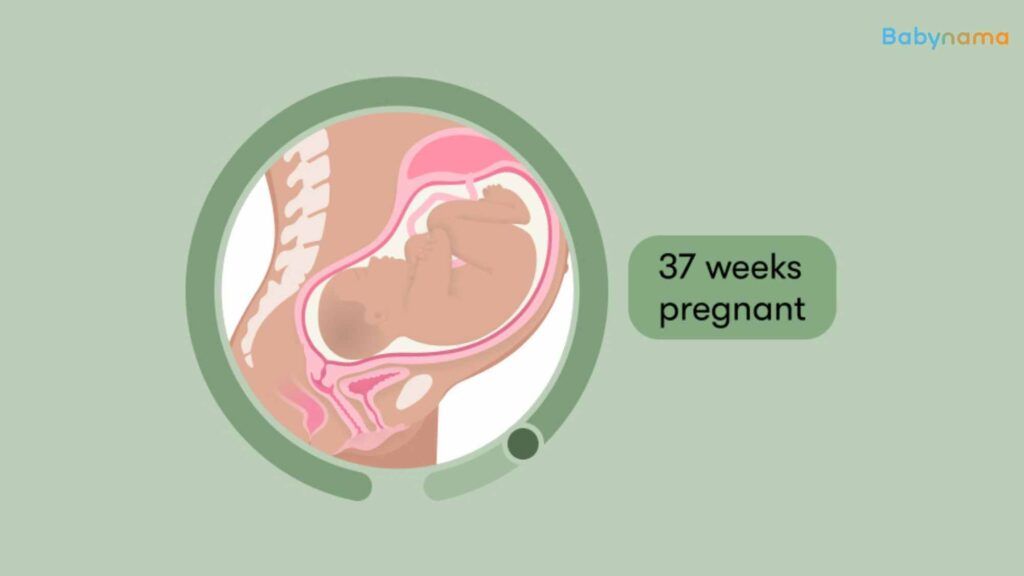
- Baby may drop into pelvis — called “lightening” or “engagement.” The head settles into the pelvic inlet. This can happen weeks before labor or during labor itself
- Lungs are nearly mature — surfactant production is sufficient for breathing in most babies
- Sucking reflex is strong — baby is practicing by sucking thumb and swallowing amniotic fluid
- Immune system getting final antibodies — you’re transferring crucial immunoglobulins through the placenta
- Baby is gaining about 200g per week — mostly fat
Early Term vs Full Term
- Early term: 37 weeks 0 days to 38 weeks 6 days
- Full term: 39 weeks 0 days to 40 weeks 6 days
- Late term: 41 weeks 0 days to 41 weeks 6 days
- Post term: 42 weeks 0 days and beyond
If there’s no medical reason for early delivery, waiting until 39 weeks is ideal — those last two weeks are important for brain and lung development.
Your Body at Week 37
Your body is actively preparing for labor. Some women notice changes this week; others don’t until much later.
Common Symptoms
| Symptom | What’s Happening | What Helps |
|---|---|---|
| Lightening / baby dropping | Baby’s head engages in pelvis. Breathing easier but peeing more | Welcome the easier breathing. Accept the frequent bathroom trips |
| Increased discharge / mucus plug | Cervix softening. Mucus plug may pass — thick, jelly-like, sometimes blood-tinged | Normal. Call doctor only if bright red bleeding |
| Nesting intensity | Strong urge to clean, organize, prepare everything | Don’t climb, lift heavy, or exhaust yourself |
| Diarrhea | Body clearing out — can be an early sign labor is approaching | Stay hydrated. It’s actually a positive sign if close to due date |
| Pelvic pain and pressure | Baby is low, pressing on everything | Warm bath. Rest. Pelvic exercises |
| Back pain — constant | Baby’s position + weight + loosened ligaments | Warm compress. Gentle stretching. Avoid standing too long |
| Difficulty sleeping | Physical discomfort + anticipation | This is normal. Rest even if you can’t sleep |
Signs Your Body Is Preparing for Labor
These are not “go to hospital” signs — they mean labor is approaching (days to weeks away):
- Mucus plug passes (bloody show)
- Increased Braxton Hicks
- Nesting urge intensifies
- Loose stools / diarrhea
- Lower back ache that comes and goes
- Baby drops lower
- Slight weight loss (1-2 kg of water weight)
Birth Preparation
When to Go to the Hospital
Use the 5-1-1 rule: Contractions every 5 minutes, lasting 1 minute each, for 1 hour.
For second or subsequent babies, use the 4-1-1 rule (every 4 minutes) — things tend to move faster.
Go IMMEDIATELY If:
- Water breaks — whether a gush or a trickle. Note the time and color. Clear = normal. Green or brown = meconium (baby passed stool — needs immediate attention)
- Heavy vaginal bleeding — soaking a pad
- Severe headache + visual changes — blurred vision, seeing spots
- Reduced or absent baby movements — any noticeable drop from your baby’s normal pattern. Do not wait to “count for hours” — go in the same day to have the heartbeat checked
- Cord visible or felt at vagina — call 112 (national emergency) or 108 (ambulance) immediately. Get on all fours, chest down, hips up. Do not push cord back
What Happens When You Arrive at Hospital
- They’ll check your cervical dilation and effacement
- Monitor baby’s heart rate (CTG/NST)
- Check if water has broken
- If you’re in active labor (usually 4-6 cm dilated), you’ll be admitted
- If early labor, they may send you home to wait — this is normal and not dismissive
Birth Plan Reminders
Discuss these with your doctor if you haven’t:
- Delayed cord clamping — 1-3 minutes. WHO recommended. Increases baby’s iron stores
- Skin-to-skin contact — immediate after birth. Helps with temperature regulation, bonding, and breastfeeding
- Breastfeeding within 1 hour — WHO recommends initiation within the first hour
- Pain management — epidural, gas and air, TENS, breathing techniques. Know what’s available at your hospital
- Birth companions — who will be with you. Many hospitals in India now allow one companion
Birth Vaccines (Within 24 Hours)
Your baby will receive these at birth:
- BCG — tuberculosis protection
- Hepatitis B (first dose) — within 24 hours
- OPV-0 — oral polio vaccine (zero dose)
These are given at the hospital before discharge. They’re part of India’s Universal Immunization Programme and are free.
Tests & Screenings Due
Weekly Visit
- Blood pressure
- Urine test
- Fundal height
- Baby’s heartbeat
- Baby’s position confirmation
- Cervical check (if doctor offers — you can decline)
- GBS results review — if positive, plan for IV antibiotics during labor
GBS Screening — Last Chance
If you haven’t done the GBS screening yet, this is the end of the 35-37 week window. Get it done this week.
Nutrition This Week
Continue
- 6 dates per day (unless gestational diabetes)
- Iron and calcium supplements
- Protein-rich meals
- Hydration — 2.5-3 litres/day
Labor Preparation
- Stock up on quick energy foods — glucose biscuits, energy bars, honey, fresh fruit juice, coconut water, or ORS (Electral / WHO-ORS) for hydration
- During early labor, light eating is usually fine. Discuss with your doctor
- Stay well-hydrated — dehydration can stall labor
When to Call Your Doctor
- 5-1-1 contractions — regular, strong, not stopping
- Water breaking — any amount
- Bleeding — more than spotting
- Baby not moving normally
- Severe headache + visual changes
- Fever above 100.4°F (38°C)
- Feeling like something is wrong — trust your instinct. Don’t wait
What’s Coming Up
- Week 38: Baby gaining 200g/week. Lungs mature. Brain and liver still developing
- Week 39: Full term. All systems go. Ideal delivery window begins
- Week 40: Due date. Only 5% of babies are born exactly on their due date
Aapke Sawaal (Common Questions)
Kya 37 weeks mein delivery karwa sakte hain?
37 weeks “early term” hai — baby premature nahi hai, lekin agar koi medical reason nahi hai toh 39 weeks tak wait karna best hai. Brain aur lungs ke liye ye last 2 weeks important hain. Agar doctor medical reason se early delivery recommend kar rahe hain (preeclampsia, gestational diabetes, growth issues) toh unki advice follow karein.
Baby “drop” hua — kya labor jaldi hoga?
Zaruri nahi. Pehli pregnancy mein baby 2-4 weeks pehle drop ho sakta hai. Second pregnancy mein baby labor ke bilkul pehle ya labor mein drop hota hai. Drop hona matlab body prepare ho rahi hai, lekin labor ka exact timing predict nahi ho sakta.
Labor pain se bahut dar lag raha hai — kya karein?
Ye feeling bahut common aur normal hai. Apne doctor se pain management options discuss karein — epidural available hai ya nahi, breathing techniques, birthing positions. Childbirth classes (online bhi available hain) mein techniques seekhein. Yaad rakhein — lakho aurtein ye kar chuki hain aur aap bhi kar sakti hain. Fear tension create karta hai jo pain badhata hai — information aur preparation se fear kam hota hai.
General information for Indian parents, not a substitute for your pediatrician. In an emergency, call 112 or 108.