
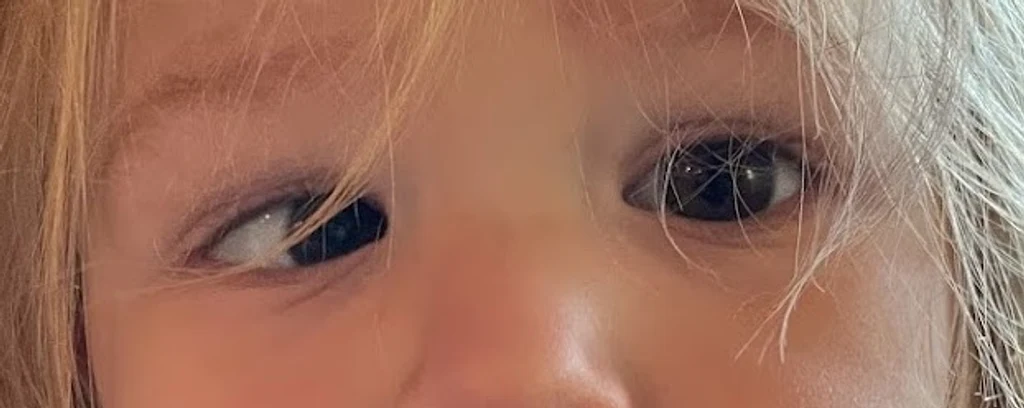
Photo: “Esotropia” by Sgfin, Wikimedia Commons, licensed under CC BY-SA 4.0.

A baby’s eyes drifting or crossing now and then in the first couple of months is usually nothing to worry about — eye muscle control is still developing. But if one eye continues to wander, turn in or out, or doesn’t seem to track together with the other past about 4-6 months, it’s worth getting checked, because this is one of the clearest examples in pediatrics where earlier action genuinely protects vision that might otherwise be lost permanently.
Quick Answer
Strabismus means the eyes are not aligned — one eye may turn in, out, up, or down relative to the other. Left untreated, strabismus (or anything else that stops one eye from working normally, like a big difference in focusing power between the eyes) can lead to amblyopia, commonly called lazy eye, where the brain starts favoring one eye and vision in the other eye fails to develop normally. Some eye drifting is normal in the first few months of life but should resolve by around 4-6 months. Signs to watch for include one eye visibly turning or wandering, a head tilt or turn to favor one eye, squinting or closing one eye in bright light, and poor depth perception or clumsiness. The reason this matters so much: the brain’s visual system is most adaptable in the first several years of life, and amblyopia treated early (patching, glasses, sometimes surgery) often restores vision well, while treatment started after about age 7-8 is far less effective and vision loss can become permanent. Get any persistent eye misalignment checked by an eye doctor, and don’t wait for a scheduled screening if you notice something.
What’s the Difference Between Strabismus and Amblyopia?
- Strabismus is a physical misalignment — the eyes point in different directions because the muscles controlling eye movement aren’t working together properly.
- Amblyopia (lazy eye) is a problem with how the brain processes vision — it happens when the brain, faced with two mismatched or conflicting images, starts suppressing or ignoring input from one eye. Over time, the “ignored” eye doesn’t develop normal vision, even though the eye itself may be structurally fine.
Strabismus is one common cause of amblyopia, but amblyopia can also happen from a big difference in focusing power (prescription) between the two eyes, or anything that blocks clear vision in one eye (like a cataract), even without visible misalignment.
Signs to Watch For
- One eye visibly turns inward, outward, upward, or downward, especially if it happens consistently or more than occasionally.
- Eyes that don’t seem to move together when following an object.
- Head tilting or turning to one side to look at things, which can be a way of compensating for misalignment.
- Squinting or closing one eye, especially in bright light.
- Poor depth perception, frequent tripping, or difficulty catching a ball.
- Holding books or objects very close to the face.
Some newborn eye drifting in the first couple of months is normal as eye muscle coordination develops, but it should be settling down by 4-6 months. Persistent misalignment after that age, or any misalignment that appears suddenly in an older child, deserves evaluation.
Why Timing Matters So Much
This is the single most important thing to understand about lazy eye: a young child’s visual system is still developing and highly adaptable, which means the brain can often be “retrained” to use a weaker eye properly if treatment starts early — commonly before about age 7-8. Beyond that window, the same treatments are much less effective, and vision loss in the affected eye can become permanent, even though the eye itself may look completely normal.
This is why routine vision screening at well-child visits matters even when nothing looks obviously wrong to a parent — many vision problems serious enough to cause amblyopia aren’t visible just by looking at a child’s eyes.
Treatment
Depending on the cause, treatment may include:
- Corrective glasses, if a difference in focusing power between the eyes is the issue.
- Patching the stronger eye for part of each day, which forces the brain to use and strengthen the weaker eye.
- Eye drops that temporarily blur vision in the stronger eye, used as an alternative to patching in some cases.
- Surgery to realign the eye muscles, for significant strabismus — often combined with patching or glasses afterward.
Most children respond well when treatment starts early, which is the whole point of catching this before school age.
When to See a Doctor
Don’t wait for a scheduled screening if you notice:
- Persistent eye misalignment after about 4-6 months of age.
- Any sudden onset of crossed or wandering eyes at any age.
- A head tilt, squinting, or consistent closing of one eye.
- Concerns raised by a teacher or anyone else about your child’s eyes or vision.
Even without any visible sign, a baseline vision check by around age 3-4 is reasonable, since some causes of amblyopia (like a prescription mismatch) aren’t visible at all from the outside.
Indian Context
Vision screening isn’t always a routine part of every well-baby visit outside major cities, so it can help to specifically ask your pediatrician to check eye alignment and tracking at checkups, and to seek a pediatric ophthalmologist’s opinion directly if you notice anything, rather than waiting for a school screening years later.
Frequently Asked Questions
Q: My newborn’s eyes sometimes cross. Should I worry?
A: Occasional eye drifting in the first couple of months is usually normal while eye muscle coordination develops. It should be resolving by around 4-6 months; persistent crossing after that age is worth checking.
Q: Can lazy eye be fixed in an older child or adult?
A: Treatment becomes much less effective after roughly age 7-8, when the visual system is less adaptable, and vision loss in the affected eye can become permanent. This is exactly why early detection matters so much.
Q: Does my child need glasses just because one eye looks different?
A: Not necessarily — an eye doctor’s exam determines the cause and the right treatment, which could be glasses, patching, drops, or surgery depending on what’s actually going on.
Q: Will patching really work, and for how long?
A: Patching is a well-established, effective treatment when used as prescribed. Duration varies by case, from a couple of hours a day to much longer, and is guided by an eye doctor based on your child’s progress.
Q: Is strabismus the same as having “cross-eyed” baby photos everyone has?
A: Brief, occasional eye crossing in early infancy is common and usually not strabismus. Consistent or frequent misalignment, especially after 4-6 months, is what warrants a check.
Noticed something about your child’s eyes and not sure if it’s worth a check-up? Join here to talk it through with other parents and our team.
This article is for general information and is not a substitute for personalised medical advice. Always consult a paediatrician or eye doctor for any concern about eye alignment or vision.
Continue with this topic
A useful next step
Baby development milestones by ageSee movement, language, social and cognitive milestones from birth to 3 years.Have a question about your little one?
Join our free community for live Q&A with MD pediatricians — no cost to join.
Join the free community