
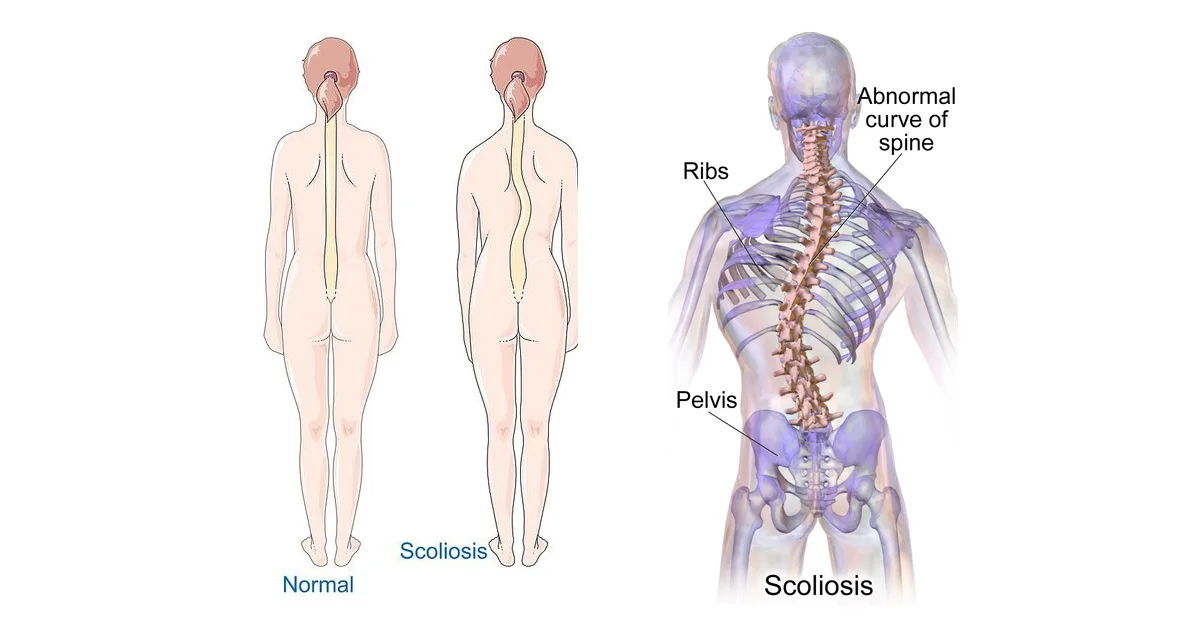
Images: “Vertebral column disorders” by Laboratoires Servier, licensed under CC BY-SA 3.0, cropped; “Scoliosis” by BruceBlaus (Blausen Medical), licensed under CC BY 3.0. Wikimedia Commons; combined by Babynama.


Scoliosis usually doesn’t announce itself with pain or obvious discomfort — which is exactly why it’s often first noticed as uneven shoulders, a tilted waistline, or picked up during a school screening, rather than something a child complains about. Most cases found this way are mild, and even when treatment is needed, catching it while a child is still growing gives the most options.
Quick Answer
Scoliosis is a sideways curvature of the spine, most commonly appearing during the growth spurt years around puberty (roughly ages 10-15), more often in girls, and most often with no identifiable cause (called adolescent idiopathic scoliosis). It usually doesn’t cause pain and is often found through screening rather than symptoms — look for uneven shoulders, one shoulder blade sticking out more than the other, an uneven waist, or one side of the back appearing higher when your child bends forward. Diagnosis is confirmed with a physical exam and an X-ray, which measures the curve’s angle. Mild curves are usually just monitored periodically; moderate curves in a still-growing child may be managed with a brace to prevent worsening; more severe curves may need surgery. The earlier it’s caught while growth remains, the more options (especially bracing) are available, which is the main reason screening and watching for the visible signs matters.
What Is Scoliosis?
A healthy spine has natural front-to-back curves, but when viewed from behind it should look straight. Scoliosis is a sideways curve, often shaped like an “S” or “C,” that develops or worsens most noticeably during periods of rapid growth. The most common type in children and teens, adolescent idiopathic scoliosis, has no single known cause — it isn’t caused by backpacks, posture, sports, or anything a child did, despite common assumptions.
Curves are measured in degrees on an X-ray, and this number guides how it’s managed: mild curves are watched, moderate curves in a growing child are often braced, and larger curves may need surgical correction.
Signs to Look For
Because scoliosis usually doesn’t hurt, especially in its early stages, it’s often noticed by looking rather than by symptoms:
- One shoulder appearing higher than the other.
- One shoulder blade sticking out more prominently than the other.
- An uneven waistline, or one hip appearing higher.
- The body leaning noticeably to one side.
- When your child bends forward at the waist (the standard screening test), one side of the back appears higher or more prominent than the other.
Persistent back pain is not typically a feature of ordinary adolescent idiopathic scoliosis — if your child has significant back pain, it’s worth mentioning to a doctor as its own concern, since pain can sometimes point to a different underlying cause that deserves separate attention, even alongside a scoliosis diagnosis.
How It’s Diagnosed
A doctor checks for scoliosis with a simple physical exam, often including the “forward bend test,” where your child bends forward at the waist with arms hanging down, making any asymmetry in the back easier to see. If a curve is suspected, an X-ray confirms it and measures the exact angle, which determines the next steps.
Treatment: It Depends on the Curve and Growth Remaining
- Mild curves are usually just monitored with periodic check-ups (often every few months during growth) to see if they’re stable or progressing.
- Moderate curves in a child who still has significant growing left may be managed with a brace, worn for a set number of hours a day, which doesn’t correct the curve but can effectively prevent it from getting worse while growth continues.
- Larger or rapidly progressing curves, or those that continue worsening despite bracing, may need surgical correction.
Many children diagnosed with scoliosis have mild curves that never progress to needing active treatment beyond periodic monitoring — a diagnosis doesn’t automatically mean bracing or surgery.
Why Early Detection Matters
Bracing works by using the remaining growth years to control how a curve develops — it’s most effective when started while a child still has meaningful growth ahead, typically before the growth spurt is mostly finished. A curve caught late, after most growth is done, has fewer non-surgical options. This is the practical reason school screening programs and watching for the visible signs above are worth taking seriously, even though most curves found this way turn out to be mild.
Indian Context
School-based scoliosis screening isn’t universal across India the way it is in some countries, so it’s worth doing an informal check yourself during the growth-spurt years — have your child stand straight and look at shoulder and waist symmetry from behind occasionally, and try the forward bend test if you notice anything. Mention any asymmetry to your pediatrician rather than waiting for it to be caught elsewhere.
Frequently Asked Questions
Q: Did my child get scoliosis from a heavy school bag or bad posture?
A: No, there’s no good evidence that backpacks or posture cause scoliosis. The most common type (adolescent idiopathic scoliosis) has no identified single cause.
Q: Does scoliosis always need a brace or surgery?
A: No — many curves found through screening are mild and are simply monitored over time without needing active treatment.
Q: At what age does scoliosis usually appear?
A: It most commonly becomes noticeable or starts progressing during the growth spurt around puberty, roughly ages 10 to 15, though it can occur at other ages too.
Q: Is scoliosis more common in girls?
A: Yes, especially the curves that are more likely to progress and need treatment, though both boys and girls can have scoliosis.
Q: Will my child need ongoing monitoring even after treatment?
A: Yes, typically — whether managed with observation, bracing, or surgery, periodic follow-up through the remaining growth years (and sometimes beyond) is standard to watch for any further change.
Noticed uneven shoulders or a tilted waist on your child? Join here to talk it through with other parents and our team while you arrange a check-up.
This article is for general information and is not a substitute for personalised medical advice. Always consult your paediatrician for any concern about your child’s spine or posture.
Continue with this topic
A useful next step
Baby development milestones by ageSee movement, language, social and cognitive milestones from birth to 3 years.Have a question about your little one?
Join our free community for live Q&A with MD pediatricians — no cost to join.
Join the free community