Quick Answer
Your baby’s bones are constantly growing and developing, and the first 2-3 years of life are the most crucial period for bone formation. Don’t worry - if you’re providing proper nutrition through breastmilk or formula, adequate Vitamin D, and allowing age-appropriate movement, your baby’s bones are on track. Here’s everything you need to know about supporting your little one’s skeletal development.
Fascinating Facts About Baby Bones
- Newborns have about 300 bones - adults only have 206!
- As babies grow, many small bones fuse together
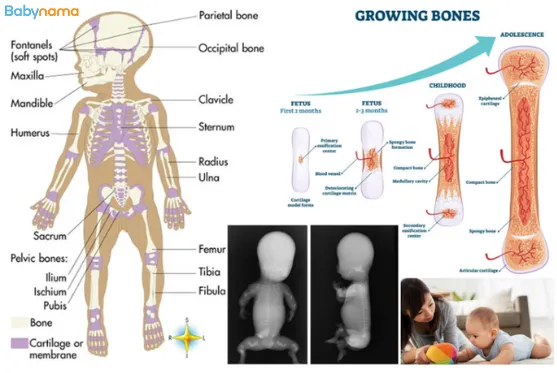
- Baby bones contain more cartilage (naram haddi), making them flexible
- The “soft spot” (fontanelle) on baby’s head is an expected part of development and usually closes between 9 and 18 months (sometimes up to 24 months)
- Most of your child’s adult bone mass is built by the end of the teen years
What Baby Bones Are Made Of: Cartilage to Bone
If your baby’s bones feel softer and more bendable than yours, that is exactly how they are meant to be. Understanding what baby bones are made of takes the worry out of a lot of common concerns.
More cartilage than bone at birth
A newborn’s skeleton is made largely of cartilage (naram haddi) — the same firm, flexible tissue you can feel in the tip of your nose or the top of your ear. This flexibility is protective: it lets your baby fold up in the womb, squeeze through the birth canal, and absorb the normal bumps of learning to move without breaking easily.
Because so much of the skeleton starts as cartilage, newborns have about 300 separate bones. As your child grows, many of these fuse together, leaving the 206 bones of an adult.
How baby bones harden: ossification
The gradual process of cartilage turning into solid, mineralised bone is called ossification. It works like a slow, orderly replacement:
- Bone-building cells lay down a firm framework where the cartilage used to be.
- Calcium and phosphorus are deposited into that framework to make it hard and strong.
- Vitamin D is essential here — without it, the body cannot absorb enough calcium to harden the bone properly.
Ossification is not finished in babyhood. It continues right through childhood and adolescence, with the long bones growing from special growth plates near their ends until the late teen years. This is why lifelong bone strength depends so much on good nutrition and movement during these early years — see our guide to the top calcium-rich foods for strong child bones.
Common Parent Concerns About Baby Bones
Soft spots (fontanelles)
The soft spot (fontanelle) on top of your baby’s head is a normal gap between the skull bones that have not yet fused. It exists on purpose: it allows the head to compress slightly during birth and gives the fast-growing brain room to expand.
What is normal:
- There are usually two soft spots — a larger one towards the front and a smaller one towards the back.
- The soft spot may look like it gently pulses; this follows your baby’s heartbeat and is expected.
- The back fontanelle typically closes in the first few months; the front one usually closes between 9 and 18 months (sometimes up to 24 months).
- A firm, flat soft spot is healthy — you can safely touch, wash, and comb over it with normal care.
This is a medical emergency, not a “book an appointment” situation: a soft spot that is bulging and tense when your baby is calm and upright — especially together with fever, vomiting, unusual sleepiness, or a seizure — can be a sign of raised pressure in the brain (from causes like meningitis). Go to the nearest hospital or call 108/112 immediately. Do not wait for a clinic appointment.
Separately, get pediatric review (not necessarily emergency) if the soft spot is deeply sunken (which can be a sign of dehydration) or has not closed by around 18-24 months.
Bowed legs and knock knees
Legs that curve outward at the knees — bow legs — are extremely common and almost always a normal stage, not a bone problem. Babies spend months curled up in the womb, so most are born with a slight outward bow that straightens on its own as they begin to stand and walk. Many toddlers then swing the other way into knock knees before the legs settle by the early school years.
This is usually just the shape of a healthy growing skeleton. It is worth a pediatric review, though, if the bowing is getting worse after age 2, affects only one leg, is very pronounced, or comes with pain or a limp. Our detailed guide on bow legs and knock knees in children explains what is normal and what is not.
Soft or fragile bones
Because baby bones are naturally soft, parents sometimes worry the bones are weak. In most well-nourished babies they are simply flexible, not fragile — though still handle your baby gently. The main preventable cause of genuinely weak, soft bones is rickets from a lack of Vitamin D — which is exactly why Vitamin D drops and sensible sun exposure matter. If you are concerned about your baby’s Vitamin D, read more about Vitamin D deficiency in children.
This is general information and not a substitute for advice from your pediatrician.
How Baby Bones Grow: Age-by-Age Guide
Newborn (0-3 months)
What’s happening:
-
Bones are soft and flexible (designed for birth!)
-
Fontanelle (soft spot) is open and may pulse - this is expected
-
Rapid bone growth requires good nutrition What baby needs:
-
Breastmilk or formula every 2-3 hours
-
Vitamin D drops (400 IU daily) if breastfed
-
Gentle handling - flexible, not fragile, but still be gentle
3-6 Months
What’s happening:
-
Bones becoming stronger
-
Baby starts bearing some weight on legs when held
-
Cartilage slowly converting to bone What baby needs:
-
Continue exclusive breastmilk or formula
-
Tummy time for muscle and bone development
-
Vitamin D supplementation continues
6-12 Months
What’s happening:
-
Major bone development supporting sitting, crawling, standing
-
First teeth appearing (calcium going to teeth too!)
-
Weight-bearing on legs increases What baby needs:
-
Breastmilk/formula PLUS solid foods
-
Calcium-rich foods: ragi, dahi, paneer (small amounts)
-
Vitamin D through sun exposure + supplements
-
Opportunities for crawling and pulling up
1-3 Years (Toddler)
What’s happening:
-
Walking strengthens leg bones
-
Bone density increasing
-
Fontanelle fully closed
-
Running, jumping further strengthen bones What baby needs:
-
Balanced diet with calcium, protein, Vitamin D
-
Physical activity - let them move!
-
Limit excessive milk (no more than 400-500ml daily)
Step-by-Step Guide: Supporting Bone Growth
Step 1: Ensure Proper Nutrition
0-6 months: Milk only
- Breastmilk provides excellent calcium
- Infant formula is fortified with calcium and Vitamin D
- No other food or water needed 6+ months: Add solid foods
| Indian Foods for Bone Health | How to Give |
|---|---|
| Ragi (nachni) | Porridge, dosa, roti |
| Dahi (curd) | Plain, with rice, in raita |
| Paneer | Mashed, small cubes |
| Sesame seeds (til) | Ground, in ladoos (older kids) |
| Green leafy vegetables | Palak/methi puree |
| Eggs | Scrambled, boiled (non-veg) |
Step 2: Don’t Skip Vitamin D
Why it’s crucial: Without Vitamin D, calcium cannot be absorbed into bones.
How to get it:
- Sunlight (dhoop)
- Sun exposure helps but is unreliable for Vitamin D in Indian babies - the UVB rays that make Vitamin D in skin are strongest around midday, not early morning, so don’t rely on “baby gets sun” as a substitute for drops
- Duration: 15-20 minutes, 3-4 times weekly, if given
- Expose arms and legs, not just face
- Indian babies may need more sun (darker skin)
- Vitamin D drops
- Breastfed babies: 400 IU daily from birth (IAP Revised 2021 Guidelines)
- Formula-fed: Ask pediatrician (formula contains some Vitamin D)
- Ask your pediatrician to recommend a suitable Vitamin D drop for your baby
Step 3: Encourage Age-Appropriate Movement
Why movement matters: Bones get stronger when they’re used!
| Age | Activities for Bone Health |
|---|---|
| 0-3 months | Tummy time, gentle stretching during massage (malish) |
| 3-6 months | Reaching for toys, supported sitting |
| 6-9 months | Crawling, pulling to stand |
| 9-12 months | Cruising, first steps |
| 1-3 years | Walking, running, climbing, dancing |
Important: Avoid baby walkers! They don’t help bone development and can delay walking.
Note on formula: All standard infant formulas sold in India are fortified to provide adequate calcium and Vitamin D for bone health when prepared correctly to the manufacturer’s instructions. Talk to your pediatrician if you have questions about which formula suits your baby.
Tips for Success
- Outdoor time in dhoop - Take baby outside for 15-20 minutes, but rely on Vitamin D drops, not sun timing, for actual Vitamin D
- Ragi is a superfood - Include in diet after 6 months
- Don’t over-dilute formula - Baby won’t get enough calcium
- Regular oil massage (malish) - Improves muscle strength supporting bones
- Track growth - Regular pediatric checkups catch issues early
Indian traditional practices: what helps and what is a myth
Helpful:
- Regular oil massage (malish): good for circulation and muscle tone, and a lovely routine, though it does not itself build bone
- Ragi in the diet from 6 months: an excellent calcium source
- Til (sesame) ladoos for older children
- Playing outdoors every day: for movement and bone-loading play. For vitamin D itself, rely on the daily drops, not on sun timing (see below)
Not helpful, or myths:
- Janam ghutti or tonics that claim to strengthen bones
- Extra ghee “for strong bones”: ghee is fine as food, but it does not build bone
- Keeping the baby indoors “for protection”: babies need floor time, movement and play for bones to strengthen
Common Mistakes to Avoid
- Skipping Vitamin D drops - “Baby gets sun” may not be enough
- Starting cow’s milk before 1 year - Hard to digest, can cause bleeding
- Too much milk after 1 year - Fills tummy, reduces appetite for solid food
- Not giving tummy time - Essential for muscle and bone development
- Using walkers - Delays proper bone and muscle development
- Incorrect formula preparation - Follow instructions exactly
If you mix breastfeeding and formula
Vitamin D drops (400 IU a day) are still recommended when a baby has both breastmilk and formula, unless your pediatrician has told you the formula volume alone covers it. Calcium needs at this age are met by milk.
1 to 3 years: what a toddler needs
- Calcium: about 500 mg a day (ICMR-NIN 2020 recommended allowance for 1 to 3 years)
- Vitamin D: 600 IU a day for children over 1 year (IAP 2021 guideline), usually as a supplement, because diet and Indian sun exposure rarely supply it reliably
Approximate calcium in common foods:
| Food | Calcium (approx.) |
|---|---|
| 1 cup milk | 300 mg |
| 1 cup dahi | 300 mg |
| 50 g paneer | 250 mg |
| 1 ragi roti | 100 mg |
| 1 tbsp til (sesame) | 88 mg |
A toddler who has stopped drinking much milk is common and usually fine: dahi, paneer, cheese, ragi, sesame and green leafy vegetables cover calcium between them.
Tests your doctor might order
If bones are a concern (bow legs worsening after age 2, delayed walking, poor growth), a pediatrician may check a vitamin D level (25-OH vitamin D), calcium and phosphate, and occasionally an X-ray. These are ordered on clinical grounds, not routinely.
Signs Your Baby’s Bones Are Developing Well
- Motor milestones arriving roughly on time (rolling, sitting, crawling, walking)
- Steady growth along their curve on the WHO chart
- Active and energetic when awake
- No unusual bowing, swelling or asymmetry of the limbs
These are reassuring general signs, but they do not rule out vitamin D deficiency or other bone problems, which can be silent early on. Keep up routine growth checks and the vitamin D drops, and bring any specific concern to your pediatrician rather than reaching for a supplement.
When to Consult a Doctor
Routine checks:
-
Regular well-baby visits (growth monitoring)
-
Ask about Vitamin D at every visit Go to hospital immediately / call 108 or 112 if:
-
Soft spot (fontanelle) is bulging and tense while your baby is calm and upright, especially with fever, vomiting, unusual sleepiness, or a seizure
Seek pediatric evaluation if:
- Soft spot (fontanelle) is deeply sunken
- Fontanelle not closed by around 18-24 months
- Baby not meeting motor milestones:
- Not holding head up by 4 months
- Not sitting by 9 months
- Not standing with support by 12 months
- Not walking by 18 months
- Unusual head shape
- Bow legs worsening after age 2
- Bones seem very fragile (easy or unexplained fractures) - this needs prompt medical assessment
- Poor weight gain
Expert Insight: Fed is best. Formula is a valid choice and provides good nutrition for your baby.
FAQs
Q: My toddler doesn’t drink milk. Will his bones be weak?
A: Many toddlers cut down on milk after a year, and that is normal. Cover calcium with dahi, paneer, cheese, ragi, sesame (til) and green leafy vegetables, keep the vitamin D supplement going, and mention it at the next check-up if you are worried. Bones need calcium, not milk specifically.
Q: My baby is on formula. Does she need calcium supplements?
A: No, standard infant formulas contain adequate calcium for babies. If prepared correctly, no extra calcium supplements are needed in the first year. After 6 months, you can add calcium-rich foods like ragi and dahi. Only give supplements if prescribed by your pediatrician.
Q: How do I know if my baby’s bones are developing well?
A: Signs of healthy bone development include: meeting motor milestones (holding head, sitting, crawling, walking on time), following the growth curve at checkups, active and energetic baby, and fontanelle closing by 18 months. If you’re concerned, your pediatrician can assess bone health and order tests if needed.
Q: Is cow’s milk better than formula for bone health?
A: No, before age 1, cow’s milk is actually not recommended because it’s harder to digest, can cause small amounts of intestinal blood loss and iron-deficiency anaemia, and doesn’t have the right nutrient balance. Infant formula is designed to provide optimal nutrition for babies, including bone-building nutrients.
Q: My 8-month-old doesn’t like ragi. What other calcium-rich foods can I give?
A: Great alternatives include: homemade dahi (2-3 spoons), mashed paneer, green vegetable purees (palak, methi), sesame seed powder (til) mixed in other foods, egg yolk (if non-veg), and fortified baby cereals. Continue breastmilk/formula which remains the primary calcium source until age 1.
Q: Will my baby’s soft spot ever close? It seems big.
A: Yes, the fontanelle (soft spot) normally closes between 9-18 months, sometimes up to 24 months. Size varies between babies and a larger fontanelle is usually not concerning if baby is developing normally. However, a soft spot that is bulging and tense while your baby is calm and upright is a medical emergency - go to hospital or call 108/112. A deeply sunken soft spot or one that hasn’t closed by around 18-24 months should be reviewed by your pediatrician.
Q: Should I give Vitamin D even though baby gets sunlight?
A: For breastfed babies, yes - Vitamin D drops are recommended even with sun exposure. Indian babies may need more sun exposure due to darker skin, and modern lifestyles often limit outdoor time. For formula-fed babies, discuss with your pediatrician as formula contains some Vitamin D.
This article was reviewed by Babynama Pediatricians. Last updated: June 2026
General information for Indian parents, not a substitute for your pediatrician. In an emergency, call 112 or 108.
Need personalized guidance? Book a consultation with our pediatricians or explore our Care Plans for 24/7 expert support!
Related Tools
Continue with this topic
A useful next step
Baby development milestones by ageSee movement, language, social and cognitive milestones from birth to 3 years.Have a question about your little one?
Join our free community for live Q&A with MD pediatricians — no cost to join.
Join the free community