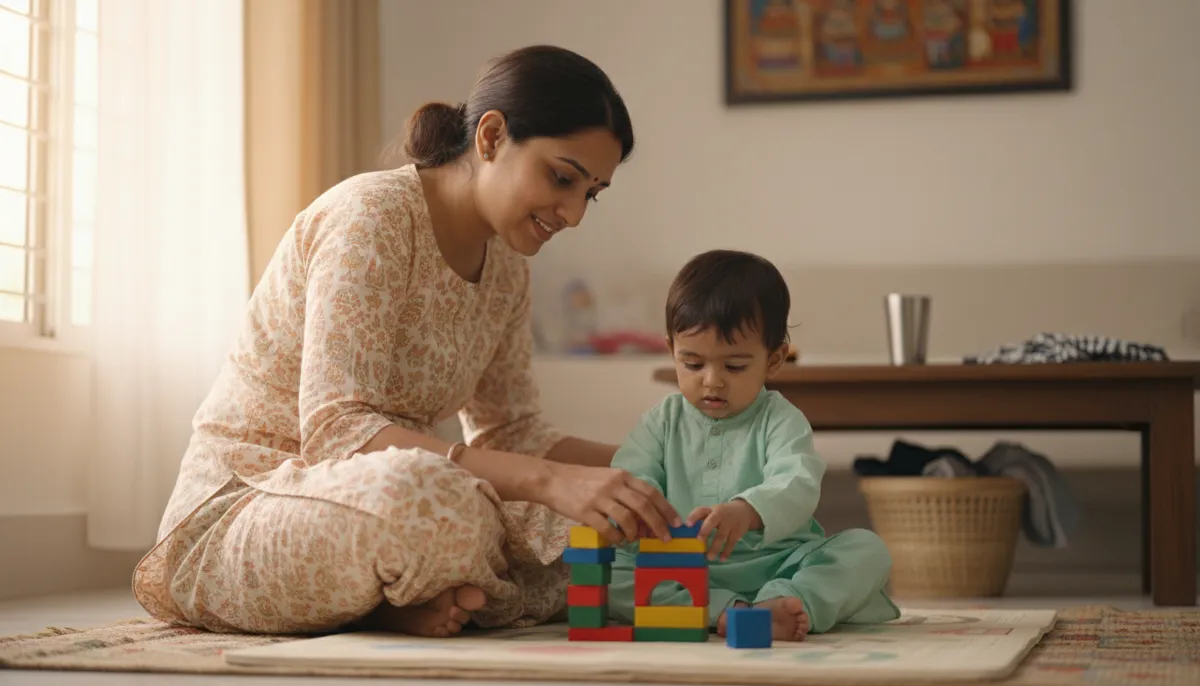
If you’re reading this at 1 AM because your baby didn’t turn around when you called their name for the third time today — take a breath. You’re not overreacting, and you’re not alone. Every year, thousands of Indian parents land on a search bar typing some version of “is this normal” about their child’s eye contact, babbling, or play. Most babies who miss one of these on a given day are not autistic.
This guide is here to help you tell the difference between the wide, normal range of how children develop and signs worth getting checked — and exactly when to bring them to a pediatrician.
What autism actually is (in plain terms)
Autism Spectrum Disorder (ASD) is a developmental condition that affects how a child communicates, interacts socially, and responds to the world around them — sounds, textures, routines. It’s called a “spectrum” because it looks different in every child: some children have significant support needs, others are highly verbal and social in some settings but struggle in others.
Two things are true at once, and both matter:
- Every child develops at their own pace. A late talker isn’t automatically autistic. Many children who are “late” catch up completely.
- Autism has reliable early signs, and noticing them early helps. Both the Indian Academy of Pediatrics (IAP) and the American Academy of Pediatrics advise starting support as soon as a concern is found, and studies show early, parent-involved therapy helps many children with communication and social skills, though how much varies from child to child.
That second point is the whole reason this article exists: not to make you worry, but to help you act early if action is needed.
Early signs, by age

No single sign on this list means your child has autism. Pediatricians look at patterns across several signs, over time — not one missed milestone on one bad day. Use this as a guide for what to watch, not a checklist to diagnose from.
Around 6 months (early and less certain)
- Rarely smiles, laughs, or shows joy with you
- Little interest in back-and-forth “conversations” of coos and babbles
At this age these are reasons to mention it at your next visit, not signs of autism on their own. If your baby doesn’t follow faces or objects with their eyes, tell your pediatrician soon, since that needs a vision and development check.
By 9 months
- Doesn’t share sounds, smiles, or other facial expressions back and forth with you
- Doesn’t respond consistently to their name being called
By 12 months
- Doesn’t babble (“ba-ba,” “da-da”) or use simple gestures like waving bye-bye or pointing
- Doesn’t point to show you something interesting (this is different from pointing to ask for something)
- Doesn’t respond to their name at all
By 16–18 months
- No single words yet
- Doesn’t bring objects to show you, or look at what you’re pointing at
- Limited eye contact during play or feeding
By 24 months
- No meaningful two-word phrases like “more milk” or “mumma come” (repeating what you just said doesn’t count)
- Loses words or social skills they previously had — this one is worth attention at any age
- Little or no simple pretend play (feeding a doll, “talking” on a toy phone) by around 2 to 2.5 years
Across the toddler years
Many toddlers do some of these now and then, and echoing words is a normal stage of learning to talk. What matters is when they happen often, most days, are intense or hard to interrupt, and show up alongside the social and communication signs above.
- Prefers to play alone consistently, even when other children are right there
- Strong, repeated interest in parts of objects (spinning wheels, lining up toys) over the toy itself
- Repetitive movements — hand-flapping, rocking, spinning
- Unusually strong reactions to sounds, lights, textures, or tastes — or unusually little reaction
- Intense need for routines to stay exactly the same; distress at small changes
- Echoing words or phrases without using them to communicate (echolalia)
What’s usually fine vs. what’s worth a conversation
Parents often ask us: “But every child is different — how do I know if this is just my child’s personality?”
Here’s the honest, evidence-based line pediatricians use:
| Common and usually fine | Worth a pediatrician conversation |
|---|---|
| Talks less than siblings did at the same age, but points, gestures, and responds to name | No words by 16 months, or not pointing or gesturing to communicate by 12 months |
| Shy in new social settings but warms up, makes eye contact with family | Consistently avoids eye contact even with parents, in comfortable settings |
| Has favorite toys or shows | Extreme distress over minor changes in routine, daily |
| Occasional repetitive play (like every toddler lining up cars sometimes) | Frequent hand-flapping, spinning, or repetitive movement that’s hard to interrupt |
| Was developing typically and still is, just at their own pace | Was babbling, waving, or using words — and then stopped |
That last row matters most. A loss of skills a child previously had — language, eye contact, social interest — is one of the clearest signals to get evaluated soon, at any age.
When to call your pediatrician
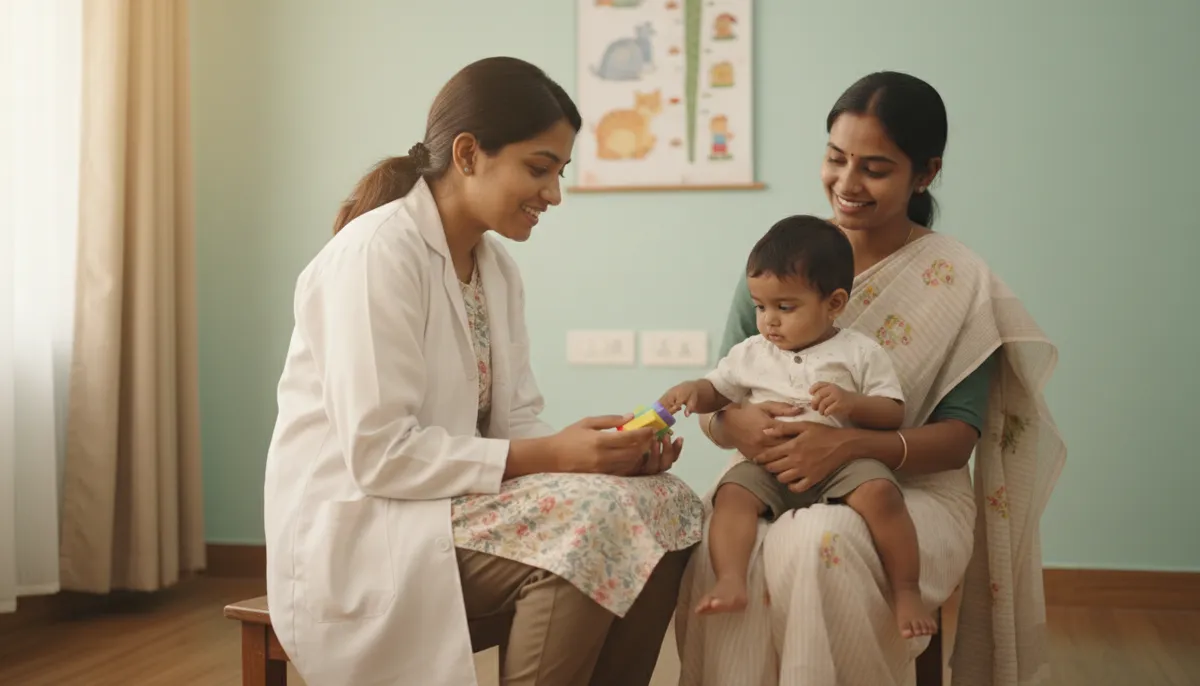
Trust your gut. You know your child better than a milestone chart does. Call your pediatrician if:
- Your child shows any one of these: no babbling, pointing, or waving by 12 months; no single words by 16 months; no meaningful two-word phrases by 24 months. Or several of the other signs above show up together and keep showing up over a few weeks.
- You notice a loss of language, social, or play skills they used to have — this is never “wait and watch.” If the loss comes with seizures, unusual staring spells, or your child seems unwell, see a doctor the same day.
- Someone who sees your child regularly, like a teacher or caregiver, has noticed the same thing you have. (A relative comparing your child to a cousin isn’t a sign on its own. And “boys talk late” is not a reason to wait if you’re worried.)
- Your child doesn’t respond to their name by 12 months, even after several calm, repeated tries.
- Something just feels off, and it’s not going away — even if you can’t name exactly what. Pediatricians would always rather screen a child who doesn’t need anything than miss one who could use support.
You do not need to wait for your child’s next scheduled checkup. If something is bothering you today, that’s reason enough to reach out today.
If you’re reading this late at night: nothing here needs action tonight, unless your child has had a seizure, has lost skills suddenly, or seems unwell; then see a doctor now. Please don’t keep testing your baby’s response to their name; tired babies ignore everyone. Tomorrow, write down what you noticed and since when, and take a short video if you can. It helps the doctor far more than a description.
What to say at the appointment:
- “I’ve noticed [what] since [when].” Show the video.
- “Can we do an M-CHAT screening?”
- “If we wait and watch, when exactly do we recheck?”
If your baby was born early, use their corrected age (age minus the weeks they were born early) when checking these milestones, until about age 2.
What happens next — screening, not a verdict
Getting evaluated is a process, not a single dramatic diagnosis moment:
- Screening. The IAP recommends that every child be screened for autism at 18 and 24 months, usually with a short parent questionnaire called the M-CHAT-R/F (Modified Checklist for Autism in Toddlers). It takes about 10 minutes. Many clinics in India don’t do it routinely, so it’s fine to ask your pediatrician for it at those visits, or sooner if you’re worried. A “positive” screen is not a diagnosis — it’s a signal to look closer. Many children who screen positive turn out not to have autism, but most of them still have some developmental need, like a speech or language delay, that benefits from support. So a positive screen always deserves follow-up.
- A hearing test comes first. Hearing loss can look exactly like not responding to their name or not talking. A clap test at home isn’t enough, so ask for a proper hearing assessment alongside any developmental evaluation.
- Referral, if needed. If screening or your pediatrician’s own observation raises concern, they’ll refer you to a developmental pediatrician, child psychiatrist or psychologist, or a Child Development Centre (many medical colleges have one). Government District Early Intervention Centres (DEICs) under the RBSK programme offer free assessment and therapy for children up to 6 years. Be cautious of anyone promising a “cure”: stem cell therapy and similar treatments are not approved for autism.
- Early intervention can often start before a formal diagnosis is finalised. Speech therapy, occupational therapy, and early behavioral support don’t need to wait for a formal diagnosis — and starting early tends to help most. If your pediatrician or evaluator recommends starting therapy while the full assessment is underway, that’s normal practice, not jumping the gun.
Common worries, answered
- Did I cause this? No. Autism is not caused by parenting, a working mother, or not talking to your baby enough.
- Do vaccines cause autism? No. Vaccines, including MR/MMR, do not cause autism; very large studies have checked this carefully. Please keep your child’s vaccines on schedule.
- Does screen time cause autism? Screens don’t cause autism, but a lot of screen time can slow speech and social play, so the IAP advises no screen time before age 2 (video calls with family are fine), and no more than 1 hour a day for ages 2 to 5.
- We speak two or three languages at home. Is that the problem? No. Growing up with more than one language does not cause autism or language delay.
The most important thing to know
An early answer isn’t about putting your child in a box. It’s about understanding how your child experiences the world, so you can support them in ways that work for them. Acting early on a worry, even before anything is confirmed, gives your child the best chance to get support when it helps most. And support helps at any age; it’s never too late to ask.
Autistic children grow, learn, connect, and build good lives. If your child does turn out to be autistic, they are still the same child you love today, and you will not be doing this alone.
You are not being paranoid by asking these questions. You are doing exactly what a good parent does.

Have a specific worry about your baby’s development? You don’t have to wait for the next appointment or sit with a 2 AM Google search alone. Message Babynama on WhatsApp — an MD pediatrician replies in under 2 minutes, any time of day, to help you figure out whether this is worth a closer look. You can also track your baby’s milestones month by month on MelloMap, Babynama’s developmental tracker.
This article is educational and does not replace an in-person medical evaluation. Only a qualified pediatrician or developmental specialist can screen or diagnose autism spectrum disorder. If you have concerns about your child’s development, please consult your pediatrician — or reach out to Babynama for guidance on next steps.
Continue with this topic
A useful next step
Browse child-development articles Explore milestones, movement, speech, behaviour and learning across childhood.Have a question about your little one?
Join our free community for live Q&A with MD pediatricians — no cost to join.
Join the free community