Quick Answer
Your 22-month-old is two months from their second birthday and it shows — they’re talking in 2-word phrases, running confidently, and their pretend play has actual storylines. “Mine!” is their new favorite word. They’re nearly ready for the 24-month milestone check, and most are tracking well. Tantrums remain a daily feature. Some children are starting to show potty training readiness.
Development Milestones This Month
At 22 months, most of the 24-month milestones are within reach.
Movement: Running is smooth and confident. They walk up stairs with both feet on each step, holding a railing or your hand. Jumping with both feet off the ground is happening for many. They kick a ball with intention and force, not just a gentle tap.
Language: 30-50 words, with 2-word phrases used regularly: “go outside,” “my ball,” “papa come,” “big truck.” They name body parts when asked and follow 2-step instructions reliably: “pick up the cup and put it on the table.” Some children are starting 3-word phrases.
Social: Pretend play now has mini-storylines — they put the doll to bed, cover it with a blanket, say “shh,” and then wake it up. They’re beginning to understand turn-taking (with lots of prompting). “Mine!” is frequent — they have a strong sense of ownership. They express a wider range of emotions and some can start to name them: “I sad,” “me angry.”
Cognitive: They complete 3-4 piece puzzles, sort objects by color or shape, and understand “same” and “different.” They’re starting to understand body part functions — “eyes see,” “ears hear,” “mouth eat.”
Feeding Guide
What Independent Eating Looks Like
By around 22 months, many toddlers are eating mostly independently — this is a range, not a deadline, so don’t worry if your child is a little behind:
- Uses a spoon with reasonable accuracy
- Drinks from an open cup with minimal spilling
- Picks up small pieces of food with fingers
- Indicates when they’re done (words, gestures, or unfortunately, throwing food)
Expanding the Menu
This is a good age to introduce new textures and flavors:
- Crunchy: Cucumber sticks, roasted papad pieces, baked vegetable chips
- Chewy: Chapati, dosa, paneer cubes
- Mixed textures: Upma with vegetables, poha with peanuts (crushed)
- New flavors: Mild pickle (aam ka achaar), chaat masala on fruit, imli chutney (mild)
Constipation
Common at this age, especially if milk intake is too high and fiber too low.
Prevention:
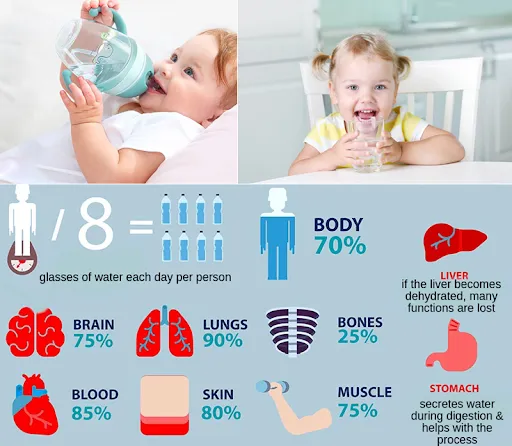
- Adequate water (4-6 cups per day including milk)
- High-fiber foods: whole grains, fruits with skin (pear, apple), vegetables, dal
- Limit milk to 300-400 ml/day
- Physical activity (running, climbing, playing)
If your toddler is straining, passing hard pellet stools, has painful bowel movements, has not passed stool for 3 or more days, or you see blood on the stool, talk to your pediatrician — sometimes a mild laxative is needed and should only be used on their advice.
Sleep This Month
11-14 hours total. One nap of 1-2 hours. Nighttime sleep 10-12 hours.
Schedule
Most 22-month-olds do well with:
- Wake: 6:30-7:00 AM
- Nap: 12:30-2:00 PM
- Bedtime: 7:30-8:00 PM
Bedtime Stalling
Toddlers at this age become experts at stalling bedtime: “one more book,” “water please,” “need to pee,” “monster in room.” This is normal limit-testing.
Counter-strategy:
- Include everything in the routine (water, bathroom, books — a set number)
- State it clearly: “We’ll read 2 books, then lights out”
- After the routine is done, be boring. Brief responses, no new activities
- If they call out after lights are off, one brief check, then done
Common Concerns
”Mine!” — Understanding Ownership
“Mine!” is not selfish behavior at 22 months — it’s a cognitive milestone. They’re understanding the concept of possession. They can’t share yet because sharing requires understanding someone else’s perspective (theory of mind), which develops around 3-4 years.
Don’t force sharing. Instead:
- Before a playdate, let them put away special toys they don’t want to share
- Model sharing yourself: “I’ll share my apple with you”
- Praise cooperative behavior when it happens naturally
- Use a timer for turn-taking: “your turn for 2 minutes, then their turn”
Picky Eating Continues
If picky eating has been going on for months, you might feel like giving up. Don’t. It takes an average of 10-15 exposures to a food before a child accepts it. Keep putting rejected foods on the plate (small amounts, no pressure). One day they’ll surprise you.
Red flag for feeding: If your child eats fewer than 10 foods total or gags on multiple textures, talk to your pediatrician — this could indicate a sensory feeding issue.
Potty Training Update
If you started introducing the potty at 21 months and your child is showing interest — great. Keep it casual and positive. If they’re not interested, shelf it for a month and try again.
Common mistake: Buying underwear too early. Keep them in diapers/pull-ups until they’re consistently using the potty. Premature switch to underwear leads to frustrating accidents.
When to See a Doctor
See your pediatrician if your 22-month-old:
- Has fewer than 20 words
- No 2-word phrases
- Can’t follow 2-step instructions
- Not running
- No pretend play
- Doesn’t respond to others’ emotions
- Doesn’t make eye contact
- Has lost skills they previously had
The 24-month well-baby visit is coming up in 2 months. Start preparing your questions and concerns.
Aapke Sawaal
Bachcha “mera mera” karta hai — share nahi karta
22 months mein sharing ka concept samajh mein nahi aata — yeh 3-4 saal ki baat hai. “Mera” bolna ek cognitive milestone hai — woh ownership samajh raha hai. Force mat karein. Turn-taking sikhayein: “pehle tera turn, phir uska turn.” Timer use karein. Time ke saath sharing aa jaayegi.
Bachcha ek hi cheez khaata hai baar baar — aur kuch nahi
Yeh “food jag” kehte hain — ek food pe fixate ho jaana. Normal hai aur usually 2-4 weeks mein khud badal jaata hai. Tab tak uss food ke saath plate mein doosri cheezein bhi rakhein. Force mat karein. Agar 10 se kam foods total khata hai ya multiple textures pe gag karta hai toh pediatrician se milein.
Constipation ho rahi hai — kya karein?
Pehle doodh ki quantity check karein — 400 ml se zyada hai toh kam karein. Paani zyada pilayein (din mein 4-6 cups). Fiber wale foods dein — sabut anaaj, phal (nashpati, apple with skin), sabziyan, dal. Physical activity badhayein. Agar fir bhi 3+ din tak motion nahi aa rahi ya dard ho raha hai toh pediatrician se milein — kabhi kabhi mild laxative zaroori hota hai.
Real Questions from Indian Mothers
These are real questions asked by parents in the Babynama community, answered by our pediatricians.
“My baby now 2 years old but milk was not produced during his birth so we give him lactogen powder.and now I am pregnant so I try to do something for milk”
Milk will get produced after child birth by reflex..the earlier you put child to breast feed The more chances for breast milk to establish
General information for Indian parents, not a substitute for your pediatrician. In an emergency, call 112 or 108.