Quick Answer
At 2 months, the real smiles arrive — and they’re worth every sleepless night. Your baby is cooing, tracking objects with their eyes, and lifting their head impressively during tummy time. Colic, if it started, is near its peak but will begin easing soon. Spitting up is probably at its worst right now. You might also notice the first hints of longer sleep stretches at night.
Development Milestones This Month
This month feels like your baby is actually becoming a person. The big developments:
Motor skills have taken a visible leap. During tummy time, your baby can now lift their head to 45-90 degrees — a huge jump from the wobbly seconds of month 0. Their movements are smoother and less jerky. If you place a lightweight rattle in their hand, they’ll grip it briefly (though they can’t reach for it yet). When you hold them upright with feet on a surface, they push down — this isn’t standing, it’s a reflex, but it shows leg strength developing.
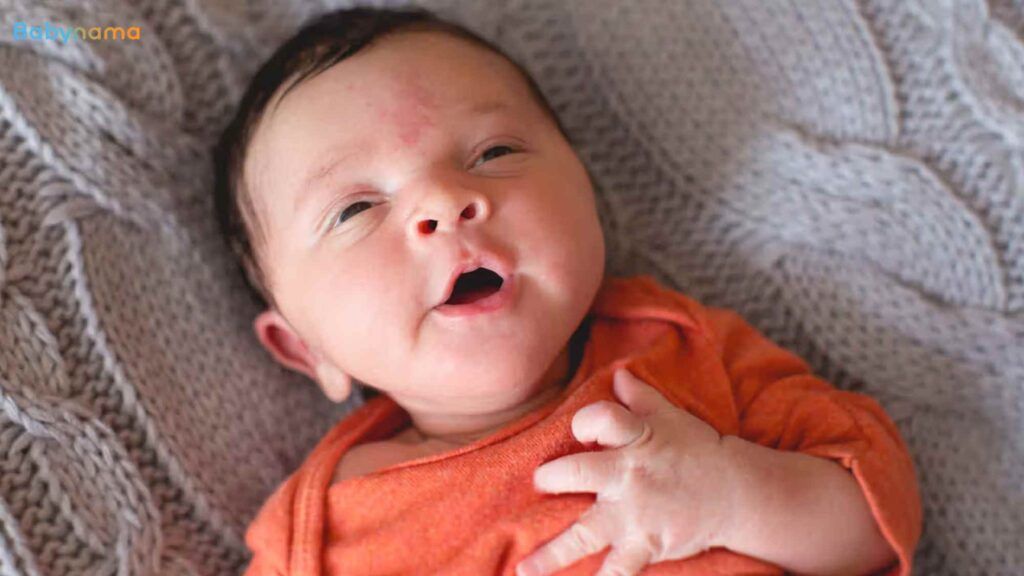
The social smile is the headline milestone. By 8 weeks, most babies have a reliable, responsive smile — they smile at you because they see you, not because of gas. They make sustained eye contact during feeds, and show excitement by waving arms and kicking legs when they see a familiar face. This is genuine social interaction.
Language moves beyond crying. Your baby starts cooing — soft vowel sounds like “oooo” and “aahh.” You’ll also notice their cries are differentiating — the hunger cry sounds different from the tired cry. They turn toward familiar voices.
Cognitively, your baby can now track a moving object smoothly with their eyes (try slowly moving a toy or your face side to side). They also show early signs of boredom — fussing when nothing interesting is happening — and anticipation — calming when picked up because they know feeding is coming.
Feeding Guide
Frequency and Efficiency
Feeds may start spacing to 7-10 times per day. Your baby is also becoming a more efficient feeder — sessions may get shorter. A feed that used to take 30-40 minutes might now take 15-20. This doesn’t mean they’re getting less milk; they’re just better at extracting it.
Spitting Up (GER)
Gastroesophageal reflux — spitting up after feeds — is extremely common and peaks between 2-4 months. Most babies spit up multiple times a day.
Normal spitting up:
- Small amounts, effortless — dribbles out rather than shoots out
- Baby is happy, feeding well, gaining weight
- Happens during or shortly after feeds
When it’s a problem (GERD):
- Projectile vomiting — forceful, travels distance
- Baby arches back and screams during or after feeds
- Poor weight gain
- Refuses feeds
To reduce spitting up:
- Keep baby upright for 15-20 minutes after feeds
- Burp mid-feed, not just at the end
- Don’t overfeed — watch for satiety cues
- Avoid tight diapers or clothing around the stomach
Most reflux resolves by 12 months as the lower esophageal sphincter matures. No medication needed for normal spitting up.
Growth Spurt at 6 Weeks
If you haven’t hit the 6-week growth spurt yet, it may happen now. Same drill — increased feeding frequency for 2-4 days, fussier baby, then back to normal. Supply adjusts to demand.
Sleep This Month
Total sleep is 14-16 hours. The exciting development: many babies start showing longer night stretches of 3-4 hours. This isn’t sleeping through the night (that’s months away), but going from 2-hour to 3-4-hour stretches feels life-changing.
Day/Night Pattern Emerging
By 8 weeks, your baby’s circadian rhythm is starting to develop. You’ll notice:
- More alert periods during the day
- Slightly longer sleep periods at night
- Some predictability to when they’re awake vs asleep
This doesn’t mean you should enforce a schedule. It means the biology is starting to sort itself out.
Naps
Expect 4-5 naps per day, varying in length from 20 minutes to 2 hours. Short naps are normal and not a problem at this age. Don’t stress about nap length — it consolidates later.
Tummy Time
Increase to 15-20 minutes total per day, spread across multiple sessions. Your baby should be lifting their head to 45-90 degrees and may start pushing up slightly on their forearms. This is building the strength needed for rolling (coming around 4-5 months).
If your baby still hates tummy time, try:
- Tummy time on your chest while you’re reclined
- A rolled towel under their chest
- Getting down on the floor face-to-face with them
- A small mirror in front of them
Common Concerns
Colic — The Peak and the Turn
If colic started at 2-3 weeks, it typically peaks around 6 weeks and then starts gradually resolving. The evening crying episodes may still be intense, but you should notice them getting slightly shorter or less frequent as you move through month 2.
If colic suddenly appears at 2 months when it wasn’t present before, make sure it’s truly colic and not something else — an ear infection, urinary tract infection, or hair tourniquet (a hair wrapped tightly around a finger or toe) can all cause sudden inconsolable crying.
Cradle Cap
Yellowish, scaly patches on the scalp. Looks worse than it is. It’s not caused by poor hygiene.
- Massage a small amount of coconut oil onto the scalp
- Gently loosen flakes with a soft brush
- Wash with mild baby shampoo
- It resolves on its own over weeks to months
Baby Acne
Small red or white bumps on the face, usually cheeks and forehead. Appears around 2-4 weeks and can persist through month 2. No treatment needed — don’t apply creams, lotions, or home remedies. It resolves on its own.
Vaccination Schedule
Vaccines due at 10 weeks (IAP schedule):
| Vaccine | Protects Against |
|---|---|
| DTwP/DTaP-2 | Diphtheria, Tetanus, Pertussis (2nd dose) |
| IPV-2 | Polio (2nd dose) |
| Hib-2 | Haemophilus influenzae type b (2nd dose) |
| Hepatitis B-3 | Hepatitis B (3rd dose) |
| Rotavirus-2 | Rotavirus diarrhea (2nd dose) |
Note: PCV (Pneumococcal) is not due at 10 weeks. The IAP uses a 2+1 PCV schedule — PCV-1 at 6 weeks, PCV-2 at 14 weeks, and a booster at 12-15 months.
Same post-vaccination care as the 6-week visit. Mild fever and fussiness for 24-48 hours is expected. The second round of vaccines generally has similar or milder reactions compared to the first.
For post-vaccine fever or discomfort: Paracetamol is dosed by your baby’s weight, not age: 15 mg/kg per dose, every 4–6 hours, max 4 doses (60 mg/kg) in 24 hours. Check the syrup strength (120 vs 250 mg/5 ml). Not for under-3-months without a doctor. Confirm the exact mL with your pediatrician.
⚠️ Remember: in a baby under 3 months, ANY fever of 100.4°F (38°C) or higher is a medical emergency — see a doctor the same day, even at night. Do not give paracetamol and wait.
🚨 Call 112 (national emergency) or 108 (ambulance), or go to the nearest hospital, if you see: difficulty/noisy breathing; swelling of face/lips/tongue; widespread hives with vomiting; pale/grey/blue skin; floppiness/unresponsiveness; or a seizure. If an adrenaline auto-injector is prescribed, use it first, then go.
When to See a Doctor
- No social smile by 8 weeks — this is a developmental screening point
- Does not track objects with eyes — should follow a slowly moving toy or face
- No reaction to loud sounds
- Cannot hold head up at all during tummy time — some wobble is fine, zero lift is a concern
- Extreme stiffness (hypertonia) or floppiness (hypotonia) — arms and legs that feel very rigid or very loose
- Projectile vomiting — not the normal spit-up dribble, but forceful vomiting that shoots out. This can indicate pyloric stenosis, especially if it starts around 3-6 weeks and gets progressively worse
- Blood in stool — could indicate cow’s milk protein allergy (even in exclusively breastfed babies, through maternal diet)
- ⚠️ In a baby under 3 months, ANY fever of 100.4°F (38°C) or higher is a medical emergency — see a doctor the same day, even at night. Do not give paracetamol and wait.
Aapke Sawaal
Baby bahut thookta hai doodh ke baad — kya normal hai?
Haan, 2-4 months mein spitting up sabse zyada hoti hai. Agar baby khush hai, achhe se feed kar raha hai, aur weight badh raha hai, toh yeh normal GER hai — “happy spitter” bolte hain. Baby ko feed ke baad 15-20 min upright rakhein aur beech mein burp karwayein. Agar baby doodh projectile vomit karta hai (door tak jaata hai), ya feed ke waqt arch karke rota hai, ya weight nahi badh raha — toh doctor ko dikhayein.
2 month pe baby ka social smile nahi aaya — chinta karein?
Kuch babies 6 weeks pe smile karte hain, kuch 8-10 weeks tak lete hain. Agar baby aapki aankh mein dekhta hai, aawaz pe react karta hai, aur movements normal hain — toh thoda wait karein. Agar 2.5-3 months tak koi social smile nahi aata, aur baby eye contact nahi banata, toh pediatrician se discuss karein. Yeh ek important developmental milestone hai.
Kya baby ko ab bhi raat mein feed karna zaroori hai?
Haan, bilkul. 2 months ka baby abhi raat bhi feed karta hai — yeh normal hai. Kuch babies 3-4 ghante ka stretch dene lagte hain, lekin poori raat sona abhi expected nahi hai. Raat ko dimm light mein chupchap feed karein — zyada interaction mat karein. Isse baby ko samajh aata hai ki raat ka waqt sone ka hai.
Real Questions from Indian Mothers
These are real questions asked by parents in the Babynama community, answered by our pediatricians.
“My baby sleeps less after feeding and it seems she becomes more active and starts playing after feed Any suggestions or observations She is 2 months old and in BF”
Distractions are very normal in this age, try to feed in quiet room where interruptions are minimal. Keep room light dim. These measures will help to reduce Distractions and prolong feeding sessions
General information for Indian parents, not a substitute for your pediatrician. In an emergency, call 112 or 108.