
Quick Answer: Current research shows that early introduction of allergenic foods (around 6 months, not before 4 months) may actually help PREVENT food allergies. Don’t delay introducing eggs, peanuts, tree nuts, fish, wheat, and dairy. Start with small amounts when baby is well, watch for reactions, and continue regular exposure. If your baby has severe eczema or existing food allergies, consult your doctor before introducing new allergens.
Understanding Food Allergies in Babies
Food allergies occur when the immune system mistakenly treats a food protein as a threat. The approach to preventing allergies has changed dramatically based on recent research.
What Changed
| Old Advice | Current Evidence-Based Advice |
|---|---|
| Delay allergenic foods until 1-3 years | Introduce around 6 months |
| Avoid peanuts in first year | Early peanut introduction may prevent allergy |
| Wait on eggs until 12 months | Eggs can start at 6 months |
| Avoid fish in infancy | Fish can start at 6 months |
The Top Food Allergens
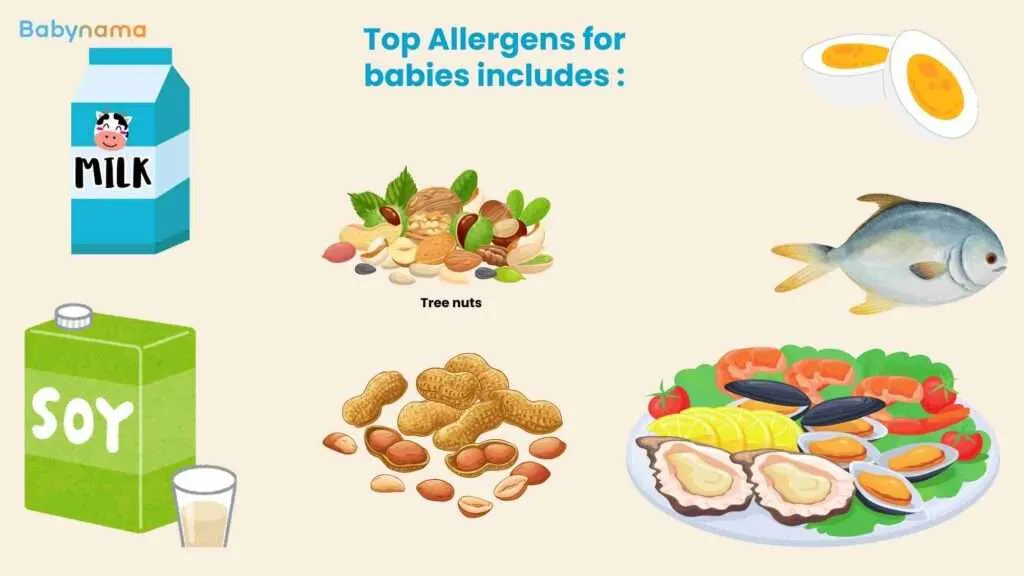
The “Big 9” Allergens
| Allergen | Indian examples |
|---|---|
| Peanuts (moongphali) | Roasted peanut powder/paste, peanut butter |
| Tree nuts | Almonds (badam), cashews (kaju), walnuts (akhrot) — as fine powder/paste |
| Eggs | Well-cooked whole egg, egg in soft khichdi or rice |
| Milk/dairy | Plain full-fat curd (dahi), paneer, cheese |
| Wheat (gehu) | Suji/dalia, soft roti, wheat porridge |
| Soy | Tofu, soy milk |
| Fish | Local soft white fish, well-cooked and deboned |
| Shellfish | Prawns, crab (in non-vegetarian coastal households) |
| Sesame (til) | Til paste, ground sesame |
In vegetarian households, focus on peanut, tree nuts, sesame (til), wheat (gehu/suji), soy and dairy (curd, paneer), introduced through familiar foods. Eggs, fish and shellfish may not be on the menu, and that is fine.
When to Introduce Allergenic Foods
Timeline
| Age | Action |
|---|---|
| Before 4 months | Only breastmilk or formula |
| Around 6 months | Start solids, can include allergens |
| 6-12 months | Introduce all allergens |
| After 12 months | Continue regular exposure |
Order of Introduction
There’s no required order, but a practical approach:
| Week | Introduce |
|---|---|
| Week 1-2 | Single-ingredient foods — single-grain porridge (ragi/rice), mashed dal, vegetables or fruit |
| Week 3+ | Can begin allergenic foods one at a time |
| Continue | Add new allergens every 3-5 days |
How to Introduce Allergens Safely
General Guidelines
| Step | Details |
|---|---|
| Start small | Tiny amount (1/4 teaspoon) first |
| When baby is well | Not during illness |
| Early in day | Can monitor for reactions |
| One at a time | Wait 3-5 days before next new allergen |
| At home | Not at restaurant or travel |
| Continue exposure | Regular intake after introduction |
Choking safety: All foods must be soft, mashed or thinned to a smooth consistency for a baby. Never give whole nuts, whole peanuts or hard chunks. Always keep your baby seated upright and supervised while feeding — never feed a baby lying down or unattended.
Specific Foods
Peanuts
How to introduce:
- Mix roasted peanut powder or smooth peanut paste into ragi/rice porridge or khichdi to a thin, smooth consistency
- Start with 1/4 teaspoon
- Smooth peanut butter thinned with water or breast milk works as an alternative Never give: Whole peanuts (choking hazard until age 4+)
Eggs
How to introduce:
- Start with well-cooked egg (hard boiled or scrambled); well-mashed yolk in rice works well
- Begin with small amount
- Can mix into khichdi, porridge or other soft foods
Tree Nuts
How to introduce:
- Nut butters (thinned)
- Nut flour in baked goods
- Nut powders mixed into purees Never give: Whole nuts (choking hazard)
Wheat
How to introduce:
- Suji/dalia (semolina) porridge or upma, soft and well-cooked
- Small pieces of soft roti
- Wheat porridge mixed into known foods
Fish
How to introduce:
- Well-cooked, flaked fish
- Remove all bones
- Start with a mild, soft local white fish
Dairy
How to introduce:
- Plain full-fat curd (dahi)
- Paneer or cheese, soft and mashed
- Mixed into curd-rice or other foods Note: Cow’s milk as main drink should wait until 12 months
Recognizing Allergic Reactions
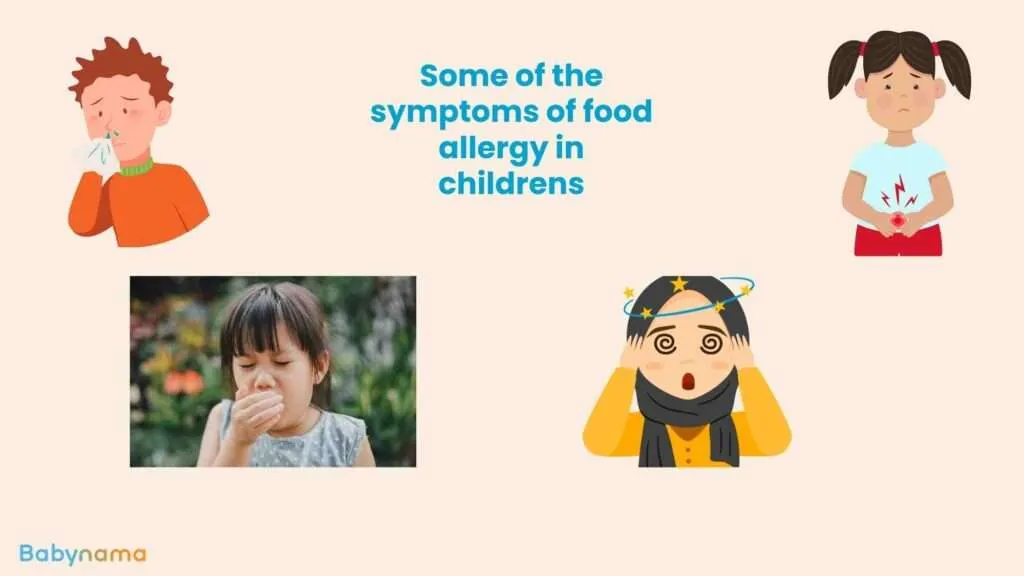
Mild to Moderate Reactions
| Symptom | Timing |
|---|---|
| Hives | Minutes to hours |
| Skin rash | Minutes to hours |
| Vomiting | Usually within 2 hours |
| Diarrhea | Hours |
| Swelling of lips/face | Minutes to hours |
| Runny nose | Minutes to hours |
Severe Reactions (Anaphylaxis) - EMERGENCY
🚨 Call 112 (national emergency) or 108 (ambulance), or go straight to the nearest hospital, if you see: difficulty or noisy breathing; swelling of the face, lips or tongue; widespread hives with vomiting; pale, grey or blue skin; floppiness or unresponsiveness; or a seizure. These can be a severe allergic reaction (anaphylaxis). If an adrenaline auto-injector has been prescribed, use it first, then go. Do not wait for a clinic appointment.
| Symptom | Action |
|---|---|
| Difficulty breathing | Call 112 / 108 or rush to nearest hospital emergency immediately |
| Wheezing | Call 112 / 108 or rush to nearest hospital emergency immediately |
| Throat tightness | Call 112 / 108 or rush to nearest hospital emergency immediately |
| Rapid heartbeat | Call 112 / 108 or rush to nearest hospital emergency immediately |
| Dizziness/fainting | Call 112 / 108 or rush to nearest hospital emergency immediately |
| Multiple symptoms at once | Call 112 / 108 or rush to nearest hospital emergency immediately |
Emergency: Anaphylaxis is life-threatening. If an adrenaline (epinephrine) auto-injector has been prescribed, use it at once, then call 112 (national emergency) or 108 (ambulance) or rush to the nearest hospital emergency. Do not wait.
High-Risk Babies
Who Is at Higher Risk?
| Risk Factor | Action |
|---|---|
| Severe eczema | Consult doctor before introducing peanuts/eggs |
| Existing food allergy | Consult allergist |
| Sibling with peanut allergy | May need testing first |
| Family history of allergies | Extra caution, but still introduce |
What High-Risk Babies Should Do
| Step | Details |
|---|---|
| See allergist | Before introducing major allergens |
| Possible testing | Skin or blood tests |
| Supervised introduction | May do in doctor’s office |
| Still introduce | Usually still recommended, just with more care |
The LEAP Study Findings
What Research Showed
The landmark LEAP study found:
| Group | Peanut allergy at age 5 years |
|---|---|
| Regular peanut consumption from infancy (enrolled 4–11 months) | 3.2% |
| Peanut avoidance | 17.2% |
This more than 80% relative reduction in peanut allergy revolutionized allergy prevention advice (Du Toit et al., LEAP, NEJM 2015; NEJMoa1414850).
What Doesn’t Prevent Allergies
Things That Don’t Help
| Myth | Reality |
|---|---|
| Avoiding allergens during pregnancy | No evidence this helps |
| Avoiding allergens while breastfeeding | No evidence this prevents baby allergies |
| Delaying introduction | May actually INCREASE allergy risk |
| Hypoallergenic formula | Not proven to prevent allergies |
| Probiotics | Limited/unclear evidence |
Maintaining Tolerance
After Introduction
| Action | Why |
|---|---|
| Continue regular exposure | Keeps tolerance active |
| 2-3 times per week | Minimum recommended frequency |
| Don’t stop and restart | Gaps may allow allergy to develop |
| Variety of preparations | Different forms of same allergen |
Example Weekly Exposure
| Day | Allergen Exposure |
|---|---|
| Monday | Mashed egg in rice or khichdi |
| Tuesday | Roasted peanut powder in ragi porridge |
| Wednesday | Curd (dahi) or curd-rice |
| Thursday | Well-cooked deboned fish (or paneer in vegetarian homes) |
| Friday | Suji/dalia porridge or soft roti |
| Saturday | Scrambled egg or paneer |
| Sunday | Til (sesame) paste or fine nut powder in porridge |
Frequently Asked Questions
Q: My baby has eczema - should I avoid allergens?
A: No - in fact, early introduction may be even MORE important for babies with eczema, who are at higher risk. However, if eczema is severe, consult your doctor or allergist before introducing peanuts and eggs.
Q: Can I introduce multiple allergens in one day?
A: It’s best to introduce new allergens one at a time, waiting 3-5 days between each new food. Once a food is tolerated, you can give it alongside other known-safe foods.
Q: What if my child had a mild reaction - can we try again?
A: Consult your doctor. Mild reactions (like a few hives) may not indicate true allergy, but should be evaluated. Your doctor may recommend allergy testing or supervised reintroduction.
Q: Do I need to wait between introducing new foods?
A: Wait 3-5 days between new foods, especially allergens. This helps identify which food caused a reaction if one occurs. Once a food is tolerated, you can continue offering it.
Q: Is organic food less allergenic?
A: No, organic foods are not less allergenic. The proteins that cause allergies are the same in organic and conventional foods.
Key Takeaways
- Early introduction helps - Around 6 months, not delayed
- Include all allergens - Peanuts, eggs, dairy, wheat, fish, nuts
- Start small - Tiny amounts first
- One at a time - Wait 3-5 days between new allergens
- Continue exposure - Regular intake maintains tolerance
- Know warning signs - Recognize allergic reactions
- High-risk babies need guidance - Consult doctor/allergist
- Don’t delay - Old advice to wait is outdated
Sources
- Indian Academy of Pediatrics (IAP) — Infant & Young Child Feeding / complementary feeding guidance (start solids around 6 months; no allergen delay).
- WHO — Complementary feeding around 6 months of age.
- Du Toit G, et al. Randomized Trial of Peanut Consumption in Infants at Risk for Peanut Allergy (LEAP). NEJM 2015; NEJMoa1414850.
- American Academy of Pediatrics (AAP) — Updates in food allergy prevention (Pediatrics 2023;152(5):e2023062836) and the 2019 clinical report on early introduction.
- ICMR-NIN — Dietary Guidelines for Indians (weaning foods).
This article is general information for Indian parents, not a substitute for examination by your pediatrician. In an emergency, call 112 or 108.
This article was reviewed by Babynama Pediatricians. Last updated: January 2026
Need personalized guidance? Book a consultation with our pediatricians or explore our Care Plans for 24/7 expert support!
Related Tools
Continue with this topic