Quick answer
No milk, egg, dal, ragi, seed, fruit, powder or special food combination can guarantee extra height. Food helps a child obtain energy, protein, fats, vitamins and minerals needed for health and normal development. Correcting undernutrition or a confirmed deficiency can matter when it is limiting growth; giving more nutrients to a child who already gets enough does not create a predictable number of extra centimetres.123
For most children aged 2 years and older, focus on a varied pattern built from familiar family foods rather than a “height diet.” If height growth is slowing, the child is crossing down percentile lines, weight or appetite is falling, the diet is very restricted, or other symptoms are present, ask a pediatrician to assess the whole growth pattern. Do not substitute a meal chart or supplement for that evaluation.23
A better goal than “foods that increase height”
Search results often turn height into a shopping or feeding problem: add more milk, protein, zinc, seeds, eggs or a powder. That framing misses two important points:
- A child can be short and healthy while growing steadily.
- A child can need assessment because growth has slowed even if they eat several foods labelled “good for height.”2
Use food to support nourishment, enjoyment and health—not to force the child toward a target height. Track height and weight accurately over time on the growth chart used by the child’s clinician. For India, the Indian Academy of Pediatrics recommends WHO growth standards below age 5 and IAP growth charts from 5 to 18 years.4
This article focuses on food for children aged 2 years and older. Babies and younger toddlers need age-specific complementary-feeding, allergy and texture guidance; do not apply the meal examples or food forms below to an infant.
Build variety with five food-group checks
India’s 2024 Dietary Guidelines recommend nutritionally adequate, balanced diets for children and adolescents and regular use of varied foods such as cereals and millets, pulses, vegetables, seasonal fruit, nuts and oilseeds, milk or curd, and eggs or flesh foods where eaten.1
You do not need every group in equal amounts at every meal. Across the day and week, ask whether the child’s usual pattern includes:
| Food-group check | Familiar Indian examples | What it contributes | Boundary |
|---|---|---|---|
| Staple or energy food | Rice, roti, idli, dosa, poha, upma, oats, millets, potato or another family staple | Energy and, depending on the food, fibre and micronutrients | Brown rice or millet is not automatically superior for every child; acceptability and the whole pattern matter |
| Protein-containing food | Dal, beans, chana, rajma, soy/tofu, egg, fish, chicken, meat, milk, curd or paneer | Protein plus nutrients that vary by food | “Contains protein” does not mean “adds height”; needs vary with age and health |
| Vegetable or fruit | Cooked vegetables, leafy vegetables, seasonal fruit | Fibre and varied vitamins/minerals | No fruit or vegetable is a height medicine; variety is more useful than a ranked superfood list |
| Calcium-containing food or planned alternative | Milk, curd, paneer, some fortified products or an individually planned alternative | Calcium, protein and other nutrients depending on the food | Dairy is not mandatory for every child and should not be forced; alternatives differ and labels need checking |
| Fat and texture appropriate to the child | Oils used in cooking; nut/seed paste or powder where safe; other family foods | Energy and essential fats | Do not give whole nuts to children under 5; form, chewing ability, allergy history and preparation matter5 |
This is a variety check, not a prescription. Portions depend on age, appetite, activity, growth, health, the rest of the diet and the family’s usual food. A pediatric dietitian can adapt it when intake is restricted or medical needs change what is appropriate.
Ordinary meal combinations
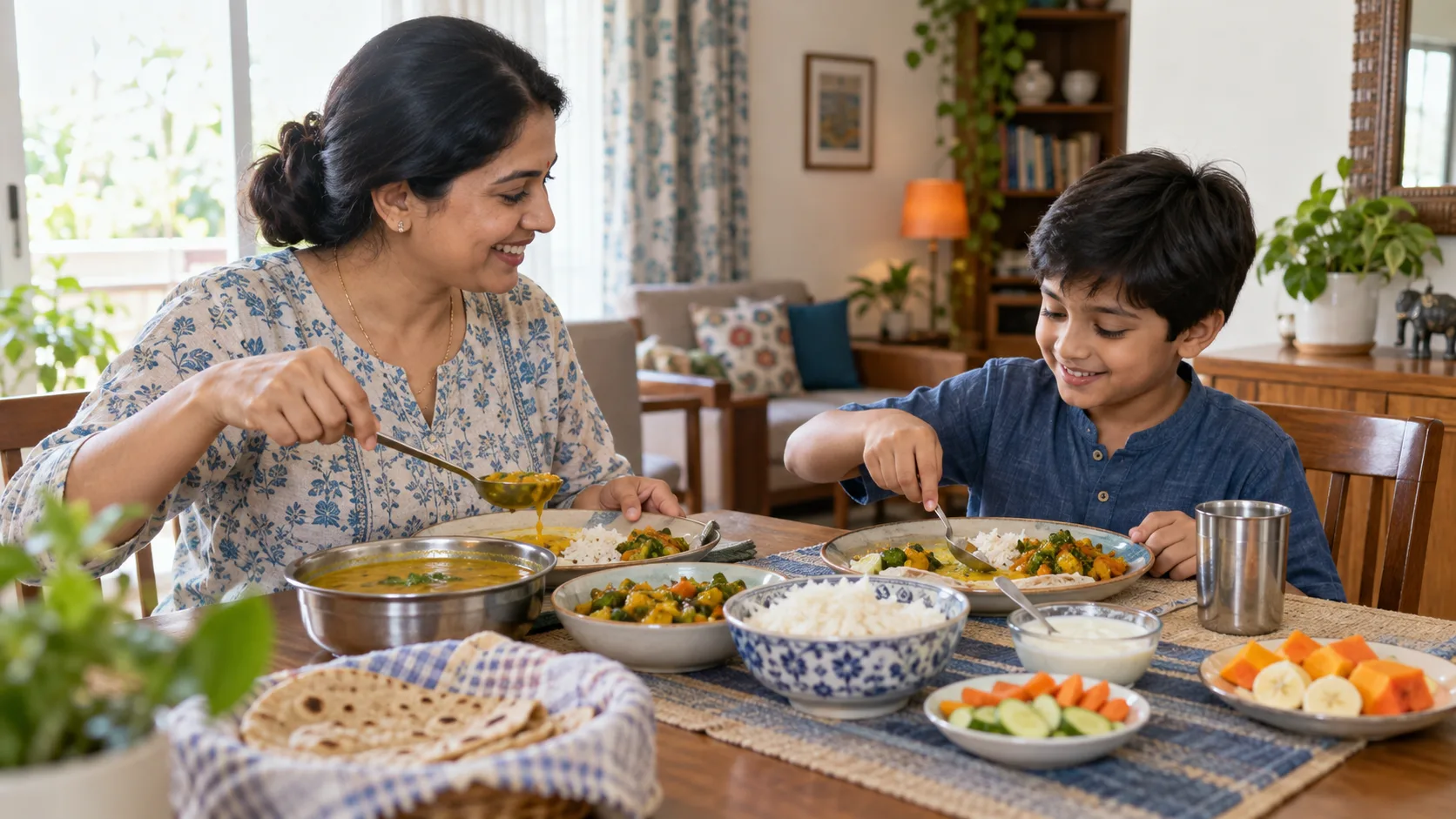
The purpose of these examples is to show combinations, not to prescribe quantities, times or compulsory foods.
Breakfast ideas
- idli or dosa with sambar, plus fruit if wanted;
- poha with peas or another vegetable, with curd where used;
- egg with roti and a vegetable;
- oats or another porridge with milk or a planned alternative, plus fruit; or
- besan or moong chilla with curd or a vegetable filling.
Main-meal ideas
- rice with dal, a cooked vegetable and curd;
- roti with chana or rajma and a vegetable;
- khichdi with vegetables and curd, egg, fish or another family side where used;
- rice or roti with fish/chicken and vegetables; or
- tofu/paneer with a staple and vegetables.
Snack ideas
- seasonal fruit with curd;
- a small family portion of cooked chana or another soft pulse preparation;
- toast/roti with a thin, safely prepared nut or seed spread when tolerated;
- leftover idli, chilla or another savoury family food; or
- milk or a suitable alternative alongside food if that fits the child’s pattern.
Do not read the list as “milk twice plus egg daily equals height.” Swap foods for allergy, culture, budget, availability and preference. A familiar simple meal can be nutritionally useful without being photographed as a perfect plate.
What the commonly marketed “growth nutrients” really mean
| Nutrient or food claim | Evidence-aware interpretation |
|---|---|
| Protein builds the body | Protein is needed for tissues and normal growth. More is not always better, and a protein food or powder cannot promise height. |
| Calcium makes bones longer | Calcium supports bone mineralisation. Bone health is not the same claim as extra linear growth. |
| Vitamin D unlocks calcium | Vitamin D is involved in calcium and bone metabolism. That does not create a universal supplement dose or sunlight timer. |
| Zinc drives growth plates | Zinc deficiency can occur and can affect health and growth. It does not follow that every short child should take zinc.6 |
| Iron prevents stunting | Iron deficiency and anemia need proper assessment and treatment. Leafy vegetables alone do not diagnose, prevent or correct every case. |
| Ragi is the best calcium food | Ragi can be one cereal in a varied diet. Nutrient content, absorption, total diet and preparation matter; it is not a height treatment. |
| Milk and eggs are complete growth foods | They can provide useful nutrients where eaten and tolerated. A child’s diet can be planned without either; neither guarantees height. |
| Seeds are concentrated nutrition | Seeds can contribute nutrients but are not mandatory. Form and amount must suit age, chewing skill, allergy history and the full diet. |
Biological mechanisms are not feeding prescriptions. A nutrient taking part in bone, cell or hormone function does not prove that extra intake in a well-nourished child increases adult height.
Vegetarian, vegan and dairy-free patterns
A vegetarian diet can support child health when it is sufficiently varied and adequate. A vegan, highly selective, multiple-allergy or medically restricted diet requires more planning because reliable sources of some nutrients may be narrower.1
Useful questions include:
- Which protein-containing foods does the child actually accept across the week?
- Is there a suitable calcium source if milk/curd is absent?
- Are fortified products being counted by the amount on the label rather than by a “healthy” front-of-pack claim?
- Is vitamin B12 reliably supplied in a vegan pattern?
- Are iron, vitamin D or other deficiencies suspected from symptoms, history or tests?
- Is the child growing steadily, and is weight changing before height?
Do not answer these questions by adding several gummies or powders. A pediatrician and pediatric dietitian can review the full pattern, growth chart, medicines and tests and decide whether food changes or a specific supplement are appropriate.
Soaking, sprouting and fermenting: useful options, not rules
Soaking, germinating/sprouting and fermenting can change the preparation, digestibility and availability of some nutrients in cereals and pulses. India’s dietary guidance includes these traditional methods as useful food-processing approaches.1
They are not mandatory at every meal and do not “unlock” a fixed amount of height. Safety and practicality still matter:
- cook beans and pulses properly;
- use clean water, utensils and hands;
- refrigerate or cook per the recipe rather than keeping wet sprouts warm for long periods;
- prepare nuts, seeds and hard foods in age-appropriate forms; and
- do not hide large quantities of a food or supplement in a child’s meal.
If the child eats ordinary well-cooked dal without sprouting it, that meal has not failed.
Supplements and “height powders”
Do not start protein powder, calcium, vitamin D, zinc, iron, multivitamin, herbal syrup, homeopathic drops or an “HGH booster” solely because a child is shorter than peers.
A useful supplement discussion starts with:
- What exact dietary or medical gap is suspected?
- What has been measured—diet history, growth pattern, symptoms or a relevant test?
- Which nutrient and chemical form does the product contain?
- What is the amount per serving, and what does the child already receive from other products?
- Is the formulation suitable for the child’s age, allergy history, swallowing/chewing ability and medicines?
- Who will decide the dose, duration, expected benefit, adverse-effect plan and review date?
A licence, celebrity endorsement, “clinically researched” badge, natural label or child-friendly flavour does not prove that a product is necessary, safe for this child or able to increase height. Bring photographs of the full label to the appointment rather than relying on the product name.
When food changes are not enough
| What you notice | Next step |
|---|---|
| The child eats a reasonably varied diet, feels well and grows steadily along a similar chart path | Continue varied family food and routine growth monitoring; do not add a height product |
| The diet is very restricted, mealtimes are distressed, the child avoids an entire food group, or allergy/medical restrictions limit choices | Ask a pediatrician and pediatric dietitian for an individual assessment |
| Appetite or weight is falling, there are persistent gut symptoms, low energy, recurrent illness or another symptom | Arrange timely pediatric assessment rather than concentrating meals or adding supplements |
| Height growth appears to slow or cross down percentile lines | Arrange pediatric assessment even if the child eats foods marketed for growth2 |
| A clinician has diagnosed undernutrition or a nutrient deficiency | Follow the specific treatment and monitoring plan; do not replace it with this article |
| Poor growth occurs with headaches or vision changes | Seek urgent medical assessment3 |
Growth concerns can relate to nutrition, chronic illness, medicines, genetic or skeletal conditions, hormones, puberty or a healthy family pattern.23 A food list cannot distinguish them.
Feeding without height pressure
- Offer food at predictable opportunities without demanding a clean plate.
- Pay attention to the child’s hunger and fullness cues; feed patiently without controlling or force-feeding.1
- Avoid saying that one bite will make them taller, stronger, smarter or more acceptable.
- Do not compare intake, body size or height with siblings and classmates.
- Ask about teasing or worry related to being short, tall, thin or heavy.
- Seek help for persistent feeding distress rather than escalating pressure or disguising supplements in food.
Nutrition matters even when it does not change height. Meals can support energy, learning, bone health, immunity, family connection and enjoyment without becoming a test of the child’s body.7
Questions parents often ask
Which food increases height fastest?
None. A varied, adequate diet supports normal growth and helps prevent nutritional gaps, but there is no food that adds predictable centimetres or works fastest.
Should my child drink milk every day for height?
Milk can provide protein, calcium and other nutrients where it is tolerated and part of the family’s diet. It is not a height medicine and should not be forced. If dairy is absent, a dietitian can help review the overall calcium, protein, vitamin B12 and vitamin D plan as relevant.
Are eggs necessary for growth?
No single food is necessary for every child. Eggs are one useful food where eaten and tolerated; protein and other nutrients can come from a varied vegetarian or non-vegetarian pattern.
Does ragi increase a child’s height?
No. Ragi is a millet that can contribute energy and nutrients. It does not override genetics, treat a growth disorder or guarantee height.
Should I give more protein if my child is short?
Not without assessing the whole diet and growth pattern. Too little intake can limit growth, but extra protein does not diagnose or solve every cause of short stature. A pediatrician or pediatric dietitian can judge whether intake is adequate.
How long before a diet change shows more height?
Do not use a short deadline or repeated home measurements to test a food. Height changes slowly, measurement error matters, and the expected rate varies with age and puberty. If growth is a concern, use serial professional measurements and the follow-up interval the clinician recommends.2
Can a supplement help if a test shows deficiency?
Sometimes a clinician will prescribe or recommend a specific nutrient when a deficiency or risk is established. That is treatment of a defined problem, not proof that the same product increases height in every child.
Where is the downloadable growth protocol?
This article does not include fixed supplement doses, “bone elongation” claims or a downloadable clinical protocol. Supplements should be selected only for an identified need with professional guidance.
Bring this food-and-growth snapshot to the appointment
- two or three typical days of foods and drinks, without trying to make them look ideal;
- accepted and refused food groups;
- allergies, dietary restrictions and feeding/swallowing concerns;
- all powders, vitamins, syrups, gummies and medicines with label photographs;
- prior height and weight measurements with dates; and
- symptoms, appetite or weight changes and the family’s main concern.
This article provides general information and does not replace individual medical advice.
Sources
Footnotes
-
ICMR–National Institute of Nutrition. Dietary Guidelines for Indians 2024. 2024. Accessed 13 September 2026. ↩ ↩2 ↩3 ↩4 ↩5
-
Pediatric Endocrine Society and American Academy of Pediatrics Section on Endocrinology Patient Education Committee. Short Stature: A Guide for Families. Accessed 13 September 2026. ↩ ↩2 ↩3 ↩4 ↩5 ↩6
-
Pediatric Endocrine Society Education Committee. Child With Suspected Short Stature: Referral Guideline. 2020. Accessed 13 September 2026. ↩ ↩2 ↩3 ↩4
-
Khadilkar V, Yadav S, Agrawal KK, et al. Revised IAP Growth Charts for Height, Weight and Body Mass Index for 5- to 18-year-old Indian Children. Indian Pediatrics. 2015;52:47–55. ↩
-
NHS. Foods to avoid giving babies and young children. Updated 27 February 2026. Accessed 13 September 2026. ↩
-
Gupta P, Shah D, Kumar P, et al. Prevention of Micronutrient Deficiencies in Young Children: Consensus Statement from the Infant and Young Child Feeding Chapter of Indian Academy of Pediatrics. Indian Pediatrics. 2019;56:577–586. Used only to establish that deficiency/risk context matters; its treatment doses are not reproduced as general height advice. ↩
-
Nemours KidsHealth. My Child Wants to Grow Taller. What Should I Say?. Accessed 13 September 2026. ↩
Continue with this topic