
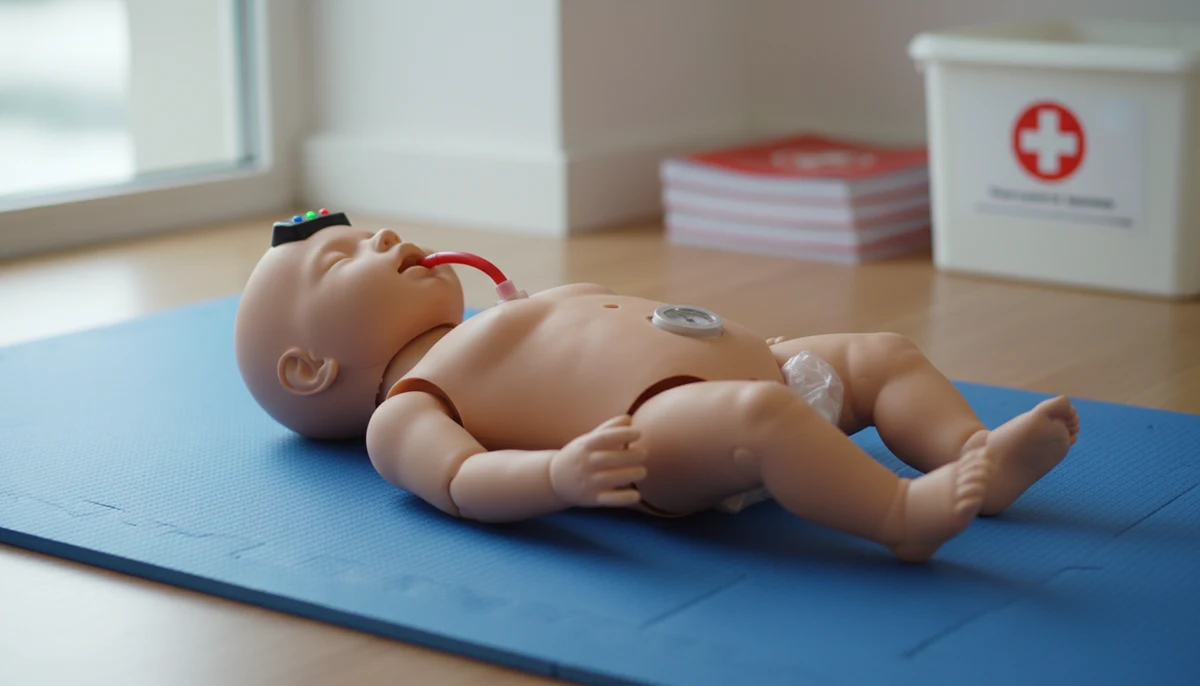
This is one topic where reading an article is genuinely not enough on its own — but knowing the basic approach, and knowing that proper hands-on training exists and is worth getting, matters a great deal. Choking and the rare cardiac emergency are frightening precisely because they require fast, correct action, and infant technique is different enough from what most adults picture that guessing in the moment is risky.
Quick Answer
If a baby or child is choking and cannot cough, cry, or breathe, the response differs by age: for infants under 1 year, it’s a cycle of back blows and chest thrusts (never abdominal thrusts on an infant); for children over 1, it’s abdominal thrusts (the Heimlich manoeuvre). If the child becomes unresponsive at any point, call emergency services (112/108) immediately — send someone else to call if you’re not alone — and begin CPR, continuing until help arrives or the child recovers. This article explains the overall approach so you know what to expect and why hands-on training matters, but it is not a substitute for a certified infant and child CPR course, where you practice the actual technique, depth, and rhythm on a training manikin under supervision. Many hospitals and Red Cross-affiliated centres in India run these courses, and taking one before you need it is one of the most genuinely useful things a new parent, caregiver, or grandparent can do.
Recognising Choking vs. Gagging
Babies and young children gag often, especially while learning to eat solids, and gagging is a normal, noisy, protective reflex that usually resolves on its own — the child coughs, grimaces, maybe goes red briefly, but can still make sounds and is getting air. True choking looks different: the child cannot cough, cry, make sound, or breathe, may clutch at their throat (in older children) or simply go silent, and can start turning blue or grey. This distinction matters because gagging needs no intervention, while silent, air-blocked choking needs immediate action.
Choking Response: Infants Under 1 Year
For a conscious infant who cannot breathe, cry, or cough:
- Support the infant face-down along your forearm, head lower than the chest, resting your forearm on your thigh for support.
- Give up to 5 firm back blows between the shoulder blades with the heel of your hand.
- If the object hasn’t come out, turn the infant face-up (still supported on your forearm, head lower than chest) and give up to 5 chest thrusts using two fingers in the centre of the chest, just below the nipple line.
- Repeat this back-blow/chest-thrust cycle until the object comes out or the infant becomes unresponsive.
Never use abdominal thrusts (the Heimlich manoeuvre) on an infant under 1 year — it carries a real risk of injuring an infant’s internal organs. This is one of the most important age-specific distinctions to know.
Choking Response: Children Over 1 Year
For a conscious child over 1 year who cannot breathe, cry, or cough, abdominal thrusts (the Heimlich manoeuvre) are used: standing or kneeling behind the child, make a fist placed just above the navel, grasp it with your other hand, and give firm, quick inward-and-upward thrusts until the object is dislodged or the child becomes unresponsive.
If the Child Becomes Unresponsive
This is an emergency. Call for help immediately — call 112/108 yourself, or have someone else call while you start CPR without delay if you’re alone with the child. CPR for infants and children follows the same general principle as adult CPR (chest compressions, with rescue breaths if you’re trained and able to give them) but uses different hand placement, depth, and technique for an infant’s smaller chest versus a child’s. This is exactly the part that’s genuinely difficult to learn correctly from text alone, and where hands-on practice on a training manikin makes the real difference between hesitating and acting correctly.
Continue CPR until emergency help arrives, the child starts breathing normally, or you’re physically unable to continue.
Why Hands-On Training Matters More Than Reading This
Infant CPR technique (two-finger or two-thumb hand placement, how deep to push, how fast) is different enough from what most people picture that a short, practical course makes a real difference in a real emergency, when stress and adrenaline make recalling written instructions much harder. Look for an accredited infant and child CPR/first-aid course — many hospitals, Red Cross chapters, and pediatric clinics across Indian cities run these for parents, grandparents, and caregivers, often in a single short session with hands-on practice.
Preventing Choking in the First Place
- Cut food into small, manageable pieces appropriate for your child’s age and chewing ability; avoid whole nuts, whole grapes, hard raw vegetable pieces, and similar hazards for young children.
- Always supervise meals and playtime with small toys or objects.
- Keep small objects (coins, button batteries, small toy parts, buttons, beads) out of reach, and be aware of what older siblings’ toys might contain.
- Avoid letting a baby or toddler eat while lying down, walking around, or in a moving vehicle without supervision.
Indian Context
Joint families often mean several caregivers — parents, grandparents, domestic help — are all involved in feeding and supervising a young child day to day. It’s worth making sure more than one regular caregiver in the household has taken a basic infant CPR and choking-response course, not just the primary parent, since emergencies don’t wait for the “right” person to be present.
Frequently Asked Questions
Q: Is compression-only CPR (no rescue breaths) okay if I’m not trained in breaths?
A: Many guidelines now support compression-only CPR by untrained bystanders as better than no action at all, though for infants and children specifically, rescue breaths are generally considered more important than in adult CPR because many pediatric emergencies involve a breathing problem rather than purely a heart problem. This is exactly the kind of detail a hands-on course clarifies for your situation.
Q: My baby coughs a lot while eating solids — is that choking?
A: Coughing, gagging, and brief redness while a baby is learning to eat is usually a normal protective reflex, not choking, as long as they can still make sound and are clearly getting air. Silent, soundless distress with no air movement is the sign of true choking that needs immediate action.
Q: Where can I actually learn this hands-on in India?
A: Many hospitals, pediatric clinics, and Red Cross Society chapters in major Indian cities offer infant and child CPR/first-aid courses for parents and caregivers — ask your pediatrician’s clinic or check with a nearby Red Cross chapter or large hospital’s community health programs.
Q: Should I try abdominal thrusts on my baby if back blows and chest thrusts aren’t working?
A: No — abdominal thrusts are not used on infants under 1 year due to injury risk. Continue the back-blow/chest-thrust cycle, and call emergency services immediately if the object doesn’t dislodge or the baby becomes unresponsive.
Q: How often should I refresh this training?
A: Many certified courses recommend refreshing every 1-2 years, since both guidelines and your own confidence/muscle memory can fade over time.
Want to find or ask about infant CPR training options near you? Join here to talk it through with other parents and our team.
This article is for general information and is not a substitute for hands-on certified first-aid and CPR training. In any choking or breathing emergency, call 112/108 immediately and begin the appropriate response without delay.
Have a question about your little one?
Join our free community for live Q&A with MD pediatricians — no cost to join.
Join the free community