Last updated: January 2026
Quick Answer
Piliya (jaundice) in newborns is extremely common - about 60% of full-term and up to 80% of premature babies develop it in their first week of life (AAP) - and most cases resolve naturally without treatment. Jaundice causes a yellowish color in baby’s skin and eyes due to bilirubin buildup. This complete guide helps Indian parents understand when jaundice is normal, how to care for baby at home, and when to seek medical help.
What is Newborn Jaundice?
Jaundice happens when bilirubin (a yellow substance from red blood cell breakdown) builds up in baby’s blood. The newborn liver is still maturing and may take a few days to efficiently process bilirubin.
Reassuring fact: In most babies, jaundice is a normal part of adjusting to life outside the womb and goes away on its own within 1-2 weeks.
About bilirubin numbers: There is no single normal bilirubin number — the safe level depends on your baby’s age in hours, gestation, and risk factors, which is why only a doctor (using a bilirubin chart) can interpret the result. Do not compare your baby’s number to another baby’s.
Types of Jaundice in Newborns
1. Physiological Jaundice (Sabse Common)
- Appears on day 2-4 of life
- Peaks at day 3-5
- Resolves by 1-2 weeks
- Treatment: Usually none needed
2. Breastfeeding Jaundice
- Occurs in first week
- Caused by baby not getting enough maa ka doodh
- Solution: Increase feeding frequency
3. Breast Milk Jaundice
- Appears after first week
- Can last 4-12 weeks
- Baby is healthy otherwise
- Do not stop breastfeeding
4. Pathological Jaundice (Needs Attention)
- Appears within 24 hours of birth
- Rises very quickly
- May indicate underlying condition
- Requires immediate evaluation
Step-by-Step Guide: Managing Jaundice at Home
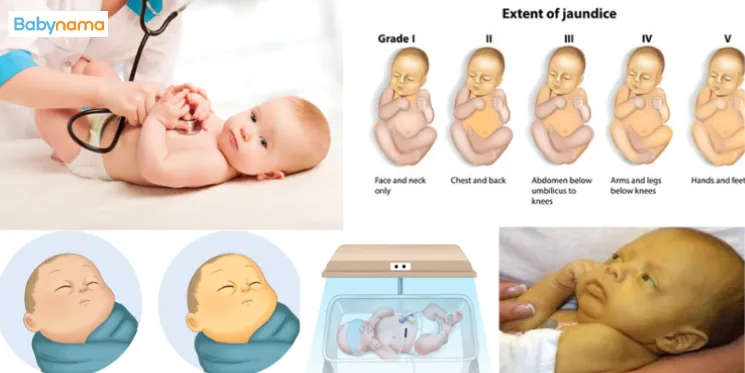
Step 1: Recognize the Signs
Check for jaundice using the “blanching test”:
-
Press gently on baby’s skin (forehead, nose, chest)
-
Look at the color when you release
-
If it looks yellowish, baby may have jaundice Where to check:
-
Start with face (mild jaundice)
-
Then chest and stomach (moderate)
-
Arms, legs, palms, soles (more significant - see doctor) Best lighting: Check in natural daylight near a window
Step 2: Feed Frequently
This is the MOST important thing you can do!
Breastfed babies:
- Feed 8-12 times in 24 hours (har 2-3 ghante)
- Wake baby for feeds if sleeping more than 3 hours
- Ensure proper latch for effective milk transfer
- Watch for signs of good feeding (audible swallowing, wet/dirty diapers)
A baby you can wake and who then feeds is fine. A baby who is floppy, very hard to wake, or won’t feed even when woken needs to be seen urgently (see danger signs below). Why feeding helps:
- Milk helps baby pass stools
- Bilirubin leaves body through poop
- More feeding = more pooping = lower bilirubin
Step 3: Monitor Baby’s Output
Signs baby is getting enough milk:
| Day of Life | Wet Diapers | Dirty Diapers |
|---|---|---|
| Day 1-2 | 1-2 | 1-2 (meconium) |
| Day 3-4 | 3-4 | 3+ (transitional) |
| Day 5+ | 6+ | 3-4 (yellow, seedy) |
Poop color matters:
- Yellow, seedy = Good!
- Green = Usually okay; but persistently green, frothy stools can mean a feeding issue worth raising with your doctor
- White/pale/clay-colored = See doctor immediately
Step 4: Follow Up as Advised
- Get bilirubin checked before hospital discharge
- Attend follow-up appointment (usually within 1-3 days of discharge)
- Keep all check-up appointments even if baby looks better
The Sunlight Myth: What Indian Parents Should Know
Many families believe putting baby in sunlight (dhoop) treats jaundice. Here’s the truth:
Home sunlight is NOT a recommended treatment for jaundice. It does not lower bilirubin to a meaningful degree, window glass blocks the useful light, and undressed newborns can quickly overheat, get sunburnt, or become dehydrated — especially in Indian heat. If your baby needs treatment, it is phototherapy under medical supervision, not sun (AAP 2022; IAP/NNF guidance).
Important warnings:
-
Never place baby in direct harsh sunlight - risk of sunburn and overheating
-
Don’t delay medical treatment hoping sun will work
-
Home sunlight is NOT a substitute for phototherapy Hospital phototherapy is:
-
Much more effective
-
Controlled and safe
-
The right treatment for significant jaundice
When to Go to the Hospital Immediately
Rush to hospital if you notice:
-
Jaundice appearing within first 24 hours of birth
-
Yellow color reaching palms of hands and soles of feet
-
Baby is very sleepy and difficult to wake for feeds
-
Baby refuses to feed or feeds poorly
-
High-pitched, unusual crying
-
Baby seems limp or has unusual muscle tone
-
Fever
-
Baby appears sick Red flags that need urgent attention:
-
Any jaundice in premature baby
-
Jaundice getting worse instead of better
-
Baby had blood group incompatibility with mother
Hospital Treatment Options
Phototherapy (Most Common)
- Baby lies under special blue lights
- Lights break down bilirubin in skin
- Very safe and effective
- Eyes protected with special covers
- Can often breastfeed during treatment
- Usually 1-2 days
Exchange Transfusion (Rare)
- Only for very severe cases
- Partial blood replacement
- Done in NICU
- Very rare when jaundice is caught early
Tips for Success
- Trust the process - Most jaundice resolves naturally
- Keep feeding - Even if baby seems sleepy, wake for feeds
- Track everything - Feedings, wet diapers, poop color
- Stay informed - Know what to watch for
- Don’t skip follow-ups - Even if baby looks better
- Ask questions - No question is silly
Common Mistakes to Avoid
- Giving water or glucose water to “flush out” jaundice (breast milk is what works!)
- Reducing breastfeeding - You should feed MORE, not less
- Relying only on home sunlight for significant jaundice
- Delaying follow-up because baby “looks fine”
- Panicking - Most jaundice is normal and treatable
- Ignoring pale stools - This needs immediate attention
Frequently Asked Questions
Q: Mera baby bahut peela lag raha hai - kya ye serious hai?
A: Mild yellowness on face and chest appearing after day 2 is usually normal physiological jaundice. However, if yellowness has spread to arms, legs, and especially palms and soles, or if baby is very sleepy/feeding poorly, see a doctor immediately. When in doubt, get baby checked.
Q: Kya breastfeeding band kar deni chahiye?
A: No! In most cases, you should breastfeed MORE frequently. Maa ka doodh helps baby pass stools which removes bilirubin. Only in very rare cases does a doctor advise a brief pause. Never stop breastfeeding without doctor’s advice.
Q: Hospital mein phototherapy ke liye admit karna padega kya?
A: It depends on bilirubin levels. Many hospitals now offer in-room phototherapy where you can stay with baby. Some cases need just a day of light therapy. Your doctor will advise based on baby’s specific situation.
Q: Dhoop kitni der dikhani chahiye?
A: Home sunlight is not a treatment for jaundice and is not recommended. It does not lower bilirubin meaningfully, window glass blocks the useful light, and an undressed newborn can quickly overheat, get sunburnt, or become dehydrated — a real risk in Indian heat. If bilirubin is high, the treatment is phototherapy under medical supervision, not dhoop. Get baby’s bilirubin checked rather than relying on sun.
Q: Jaundice se brain damage ho sakta hai kya?
A: Severe untreated jaundice with very high bilirubin can rarely cause brain damage (kernicterus). This is exactly why monitoring is important. With proper follow-up and timely treatment when needed, this complication is preventable. The early, still-reversible warning signs to act on immediately are: poor feeding or won’t feed even when woken, unusual sleepiness or floppiness, a high-pitched cry, and arching of the neck or body backwards. If you see any of these in a jaundiced baby, go to the nearest hospital straight away — do not wait for a follow-up appointment. Otherwise, don’t let this scare you — just keep your follow-up appointments.
Q: Second baby ko bhi jaundice hoga kya?
A: Not necessarily. Each pregnancy and baby is different. However, if your first baby had significant jaundice, inform your doctor so they can monitor your next baby closely.
This article was reviewed by Babynama Pediatricians. Newborn jaundice is common and most cases are mild, but it can occasionally become serious — when in doubt, always get your baby checked.
This article is general information for Indian parents, not a substitute for examination by your pediatrician. In an emergency, call 112 or 108.
Need personalized guidance? Book a consultation with our pediatricians or explore our Care Plans for 24/7 expert support!
Have a question about your little one?
Join our free community for live Q&A with MD pediatricians — no cost to join.
Join the free community