Quick Answer
Understanding your child’s emotional development is just as important as tracking their weight and height! Erikson’s stages of development explain how children develop emotionally and socially at different ages. Don’t worry if your child seems to struggle at any stage - this is a common part of growing up, and most children navigate these challenges with loving support. These ages are broad ranges, not fixed deadlines. If your child is clearly behind peers in talking, playing, or connecting with others, talk to your pediatrician.
The 8 Stages - What Parents Need to Know
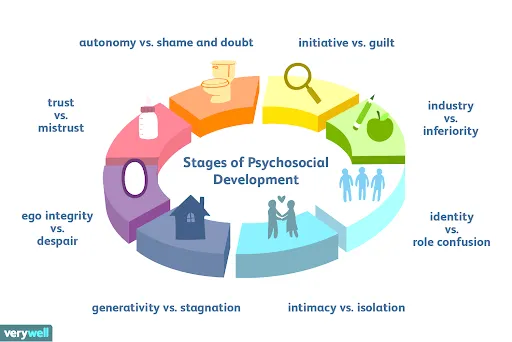
Stage 1: Trust vs. Mistrust (0-18 months)
Your baby asks: “Can I trust the world?”
What helps:
- Respond to crying promptly
- Consistent care and routines
- Physical touch and eye contact
- You CAN’T spoil a baby!
Outcome: Baby feels secure and trusting
Stage 2: Autonomy vs. Shame (18 months - 3 years)
Your toddler asks: “Can I do things myself?”
What helps:
- Offer age-appropriate choices
- Patience with potty training
- Let them try (even if messy!)
- Set loving limits
Note: “No” and tantrums are a developmentally expected part of this stage.
Stage 3: Initiative vs. Guilt (3-5 years)
Your preschooler asks: “Can I make things happen?”
What helps:
- Encourage creative play
- Answer questions patiently
- Let them “help” with tasks
- Gentle discipline, no shaming
Note: Wild imagination and endless questions are healthy and expected!
Stage 4: Industry vs. Inferiority (6-12 years)
Your school-age child asks: “Am I capable?”
What helps:
- Celebrate effort, not just results
- Help find activities where they excel
- Don’t compare to siblings/others
- Support through challenges
Stage 5-8: Adolescence and Beyond
- Identity vs. Role Confusion (12-18)
- Intimacy vs. Isolation (Young Adult)
- Generativity vs. Stagnation (Middle Adult)
- Integrity vs. Despair (Late Adult)
When to Worry
Contact your pediatrician if:
- Extreme difficulty separating from parents
- Complete lack of interest in others
- Persistent, severe anxiety
- Significant behavior regression
- Signs of depression
What You Can Do
- Be consistent - Predictability builds security
- Show unconditional love - Separate behavior from child
- Allow independence - Let them try and sometimes fail
- Praise effort - “You worked so hard!”
- Model healthy behavior - Children learn by watching
Expert Insight: Babynama Pediatricians: “Emotional milestones, like physical ones, unfold over a range of ages. Watch the overall pattern of how your child connects, plays, and copes - not a single moment - and reach out if something feels off.”
FAQs
Q: My 2-year-old says “no” to everything - is this normal?
A: Yes, this is very common. It is healthy development - your toddler is learning they’re a separate person. Offer limited choices and pick your battles.
Q: My child is struggling in school and says they’re “dumb” - what should I do?
A: Help by finding activities where they excel, praising effort over results, and never comparing to others. Focus on their strengths while supporting challenges.
Q: How do I balance Indian values with allowing independence?
A: You can honor both! Offer choices within acceptable options, explain “why” behind rules, and remember that healthy independence doesn’t mean disrespect.
This article was reviewed by Babynama Pediatricians. Last updated: January 2025
Need personalized guidance? Book a consultation with our pediatricians or explore our Care Plans for 24/7 expert support!
Related Tools
General information for Indian parents, not a substitute for your pediatrician. In an emergency, call 112 or 108.
Continue with this topic
A useful next step
Baby development milestones by ageSee movement, language, social and cognitive milestones from birth to 3 years.Have a question about your little one?
Join our free community for live Q&A with MD pediatricians — no cost to join.
Join the free community