Quick Answer
Many cases of red eyes (aankh aana) in older children are mild and can be managed at home with simple supportive care. For mild irritation or allergic redness without fever, severe pain, or vision changes, gentle home care is often enough while the eye settles. But any baby under 3 months with a red or sticky eye needs to be seen by a doctor the same day — newborn eye infections can be serious. Also see a doctor if symptoms don’t improve within 2-3 days, worsen, or come with eye pain or vision problems.
Understanding Red Eyes in Children
Red eyes or laal aankh is a common concern for Indian parents. Before trying home remedies, it’s important to understand that red eyes can be caused by:
- Viral infection - Often comes with sardi-khansi (cold and cough)
- Bacterial infection - Causes thick, sticky discharge
- Allergies - Dust, pollen, or pet dander
- Irritation - Smoke, pollution, chlorine from swimming pools
- Tiredness - Lack of sleep or too much screen time
Age-Specific Home Care Guide
For Babies (0-12 months)
Gentle Care (always check with your pediatrician first for this age):
- Warm water cleaning: Gently wipe crusty or sticky eyes with a fresh piece of cotton dipped in cooled, boiled water — a clean wipe for each eye, from the inner corner outward. This is the safest at-home step for babies.
- Sterile eye saline: Only use a saline made for the eyes, prescribed or recommended by your doctor or chemist. Do not put nasal saline drops into a baby’s eye.
What NOT to do:
- Don’t put breast milk in the eye. It is widely used as a gharelu nuskha, but there is no proven benefit and it can introduce bacteria into the eye — discuss with your pediatrician instead.
- Don’t use kajal or surma — these can irritate the eyes and introduce infection.
- Don’t use honey, turmeric, rose water, or any herbal/folk eye drops in a baby’s eye.
- For any baby under 3 months, do not try to treat a red or sticky eye at home — see a doctor the same day.
For Toddlers (1-3 years)
Safe Remedies:
- All baby-safe steps above
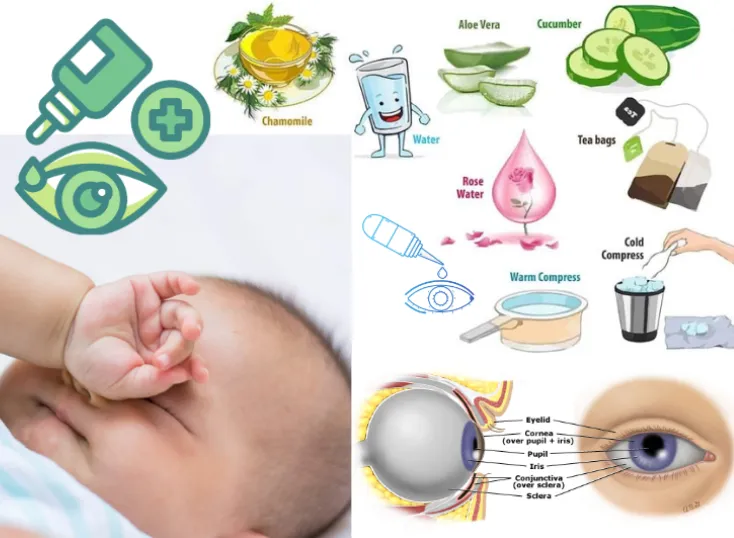
- Cold compress: For allergic red, itchy eyes, place a clean cloth soaked in cold water on closed eyes for 5-10 minutes
- Cucumber slices: Chilled cucumber on closed eyes for relief (only if the child cooperates)
- Rose water (Gulab Jal): Widely used on cotton pads over closed eyes, but it has no proven benefit and can sting or irritate — do not drop it into the eye, and discuss with your pediatrician before using.
For Older Children (3+ years)
Safe Remedies:
- All above steps
- Warm compress: For sticky discharge, a warm (not hot) clean cloth on closed eyes helps loosen crust
- Cooled chamomile tea compress: Some parents place cotton soaked in cooled chamomile tea over closed eyes. It is a folk remedy with no proven benefit — do not use it as an eye wash or drop it into the eye, and discuss with your pediatrician first.
- Turmeric (haldi) water: A popular gharelu nuskha, but do not rinse or drop turmeric water into a child’s eye — there is no proven benefit and it can irritate or contaminate the eye.
Step-by-Step Home Remedies (Gharelu Nuskhe)
1. Gentle Eye Cleaning (Safest First Step)
How to do it:
- Wash your hands thoroughly with soap
- Boil water and let it cool to lukewarm
- Dip a fresh piece of clean cotton in the cooled boiled water
- Gently wipe each eye from the inner corner outward
- Use a separate piece of cotton for each eye and each wipe
- Repeat as needed to keep the eye clean of crust and discharge
A note on breast milk: Putting breast milk in the eye is a widely used home remedy, but it has no proven benefit and can introduce bacteria into the eye. Don’t rely on it — clean the eye gently with cooled boiled water and see your pediatrician.
2. Eye Cleaning with Sterile Saline
Important: Use a sterile saline made for the eyes, recommended by your doctor or chemist. Avoid mixing salt water at home for the eye — it can be the wrong concentration, sting, or be non-sterile.
How to use:
- Wash your hands first
- Use a clean dropper or fresh cotton with the sterile eye saline
- Gently clean the eye from inner corner to outer corner
- Use fresh cotton for each wipe and a separate one for each eye
- Do this 3-4 times daily, or as your doctor advises
3. Rose Water (Gulab Jal) Compress — Folk Remedy
Rose water on cotton pads over closed eyes is widely used, but it has no proven medical benefit and can sting or irritate. Never drop rose water into the eye. Discuss with your pediatrician before using, and stop if it causes any discomfort.
4. Warm Compress for Sticky Eyes
How to do it:
- Soak a clean, soft cloth in warm (not hot) water
- Wring out excess water
- Place on closed eyes for 5-10 minutes
- Gently wipe away any crust
- Use a fresh cloth each time Best for: Bacterial conjunctivitis with thick discharge
5. Cold Compress for Allergic Eyes
How to do it:
- Wrap ice cubes in a clean cloth, OR
- Use a cloth soaked in cold water
- Apply to closed eyes for 5-10 minutes
- Repeat as needed Best for: Allergic conjunctivitis with itching
6. Chamomile Tea Compress — Folk Remedy
Cooled chamomile tea on cotton pads over closed eyes is sometimes used for soothing, but it has no proven benefit. Do not use it as an eye wash and do not drop it into the eye — it is not sterile and can irritate or infect. Discuss with your pediatrician first.
Important Hygiene Tips
- Haath dhona: Wash hands before and after touching eyes
- Alag towel: Use separate towels for affected child
- Pillow cover: Change pillow covers daily
- No sharing: Don’t share eye drops, towels, or washcloths
- School: Keep child home until discharge stops
- No rubbing: Teach children not to rub their eyes
When Home Remedies Are NOT Enough
See a Doctor Immediately If:
- Baby under 3 months with any red, sticky, or discharging eye — see a doctor the same day, do not treat at home
- Any fever in a baby under 3 months (100.4°F/38°C or higher) — this is a same-day emergency
- Severe pain in the eye
- Vision problems or blurred vision, or sensitivity to light
- Swelling, redness, or warmth spreading beyond the eyelid onto the cheek or around the eye
- No improvement after 2-3 days of home care, or symptoms getting worse
- Thick yellow or green discharge that keeps increasing
- Child cannot open the eye due to swelling
What Doctor May Prescribe:
- Antibiotic eye drops (for bacterial conjunctivitis) — for example moxifloxacin, ofloxacin, or tobramycin, only as prescribed by a doctor
- Antihistamine drops — for allergic conjunctivitis
- Lubricating (artificial tear) drops — to soothe dryness and irritation
Use any eye drops only on a doctor’s prescription and at the prescribed dose — do not self-medicate a child’s eyes.
Prevention Tips for Indian Families
- Haath dhulai: Make handwashing a habit, especially after coming home
- Aankh mat ragado: Teach children not to touch or rub eyes
- Saaf towel: Use clean, separate towels for face
- Dhool se bachao: Protect eyes from dust and pollution
- Screen time: Limit TV and mobile use to prevent eye strain
- Swimming: Use goggles in swimming pools
- Nutrition: Include vitamin A rich foods - gajar (carrot), papita (papaya), palak (spinach)
FAQs
Q: Can I use kajal or surma for my baby’s red eyes?
A: No, avoid kajal and surma entirely. These can introduce more bacteria and make the infection worse. They are not recommended by pediatricians for any eye condition.
Q: How long does red eye take to heal with home remedies?
A: Mild viral conjunctivitis usually improves in 5-7 days. Bacterial conjunctivitis with home care may take longer. If no improvement in 3-4 days, see a doctor.
Q: Can red eye spread to other family members?
A: Yes, viral and bacterial conjunctivitis are very contagious. Maintain strict hygiene - separate towels, frequent handwashing, avoid touching face.
Q: Is it safe to send my child to school with red eye?
A: No, keep your child home until there is no discharge and redness has significantly reduced. This prevents spreading to other children.
Q: Can I use the same home remedies for both eyes?
A: Always use separate cotton/cloth for each eye to prevent spreading infection from one eye to the other. Start with the less affected eye.
Q: My child’s eyes are red but there’s no discharge. What could it be?
A: This could be allergic conjunctivitis, eye strain from screens, or tiredness. Try cold compress and reducing screen time. If it persists, consult a doctor.
This article was reviewed by Babynama Pediatricians.
Need quick advice about your child’s red eyes? Chat with Babynama’s pediatricians on WhatsApp for immediate guidance.
General information for Indian parents, not a substitute for your pediatrician. In an emergency, call 112 or 108.
Need personalized guidance? Book a consultation with our pediatricians or explore our Care Plans for 24/7 expert support!
Have a question about your little one?
Join our free community for live Q&A with MD pediatricians — no cost to join.
Join the free community