
Quick Answer: Yes, you can naturally increase your breast milk supply. The key is frequent feeding/pumping, proper nutrition, and hydration. Once feeding is established, most mothers produce enough milk and low supply is more often a perception issue than reality. In the first two weeks that reassurance does not apply yet - read the next section first.
If Your Baby Is Under 2 Weeks Old, Read This First
Everything below about “most mothers are producing enough” is true for settled, established feeding. It is not a reason to wait and watch in the newborn period. Newborns who take too little milk can become dehydrated quickly, and the early signs are quiet and easy to miss: a baby who under-feeds is often sleepy and undemanding rather than crying.
🚨 Take your baby to a doctor the same day if any of these are present:
- Weight loss of more than 10% of birth weight, or not back to birth weight by 2 to 3 weeks
- Very sleepy, floppy, or hard to wake for feeds; will not feed, or feeds weakly
- No urine for 8 hours or more, or fewer nappies than the day-by-day counts below
- Yellow colour of the skin or eyes appearing in the first 24 hours of life, yellowing of the palms or soles at any time, or jaundice with poor feeding or sleepiness
- Dry mouth or tongue, no tears when crying, sunken soft spot (fontanelle), sunken eyes, cold or mottled hands and feet
- Fever, low temperature, fast or difficult breathing, a weak or high-pitched cry, or fewer movements than usual
In an emergency, call 112 or 108. Yellow palms and soles, or jaundice with lethargy and poor feeding, are urgent-referral signs under India’s IMNCI newborn protocol, not “wait for the next visit” signs.
Is Your Milk Supply Actually Low?
Before trying to increase supply, let’s check if you actually have low supply. Many mothers worry unnecessarily.
Signs your supply is FINE:
- Baby is gaining weight steadily (check with your pediatrician)
- Enough wet nappies for your baby’s age (see the day-by-day counts below)
- Baby wakes for feeds, feeds actively, and is alert at some point in the day
- You hear swallowing during feeding
Signs you may need to boost supply:
- Baby is not gaining weight as expected, or is losing weight
- Fewer wet nappies than the day-by-day counts below
- Baby seems hungry immediately after long feeds
- Very little output when pumping (though pumping output varies)
Note the difference between a content baby and a sleepy, hard-to-wake one. A baby who rarely demands feeds, is difficult to rouse, or falls asleep within a few minutes of latching is not reassuring, even if they seem “settled.” That baby needs to be checked. A significantly under-fed, dehydrated or jaundiced newborn is characteristically quiet and undemanding, which is exactly why “he’s such a good baby, he never cries” can be the wrong thing to be reassured by.
Wet Nappies by Day
In the first few days there is only colostrum, in small amounts, so a day-2 mother counting six wet nappies is measuring herself against the wrong number.
- Roughly one wet nappy per day of life at first: 1 on day 1, 2 on day 2, 3 on day 3, and so on
- From about day 4 to 5 onwards: 6 or more wet nappies a day
- Tell your doctor if you see orange or brick-red staining in the nappy after day 3 (urate crystals), or if stools are still black by day 5
Weight Is the Real Measure in the Newborn Period
Nappy counts and how settled your baby seems are useful, but in the first weeks weight is the number that actually decides things.
- In the first 2 weeks: weight loss of more than 7% of birth weight needs a proper feeding assessment; more than 10% needs same-day medical review; and your baby should be back to birth weight by day 10 to 14. Weigh at day 3 to 5 and again at day 10 to 14, on the same scale, ideally without clothes or nappy.
- After 2 weeks: watch for weight gain that has flattened or fallen away from your baby’s growth curve, or any weight loss at all.
Ask for your baby’s weight to be plotted on the WHO growth standards, which the Indian Academy of Pediatrics endorses for children from birth to 5 years. US CDC charts are not the right reference for this age group in India.
Reassurance: Once feeding is established, most mothers produce enough milk. If your baby is gaining weight along their curve, waking to feed actively, and having enough wet nappies for their age, your supply is very likely fine.
7 Natural Ways to Increase Breast Milk Supply
1. Feed More Frequently (Demand = Supply)
Breast milk works on supply and demand. The more you empty your breasts, the more milk you’ll produce.
What to do:
- Feed every 2-3 hours in the early weeks
- Don’t watch the clock - feed on demand
- Offer both breasts at each feeding
- Allow baby to finish one breast before switching
For working mothers: Pump at the same times your baby would normally feed to maintain supply.
“Feed on demand” has one exception. A newborn who is not feeding enough often stops demanding. In the first 2 weeks, if your baby has gone more than 3 to 4 hours without waking for a feed, wake them and offer the breast rather than letting them sleep through. If you cannot rouse them, or they latch and fall asleep within a couple of minutes, that is a same-day check with your doctor, not something to solve with more pumping.
2. Power Pumping (Pump Badhane Ka Tarika)
Power pumping mimics cluster feeding and signals your body to produce more milk.
How to power pump (do once daily for 3-5 days):
- Pump for 20 minutes
- Rest for 10 minutes
- Pump for 10 minutes
- Rest for 10 minutes
- Pump for 10 minutes
Best time: Evening hours when prolactin levels are naturally higher.
3. Indian Galactagogues (Doodh Badhane Wale Foods)
These traditional Indian foods are widely used to boost milk supply. Note: most galactagogues have no strong proven benefit and evidence is mixed — they are safe to include as nourishing foods, but discuss with your pediatrician or lactation consultant before relying on any single remedy.
| Food | How to Use | Notes |
|---|---|---|
| Methi (Fenugreek) | 1 tsp seeds in water overnight, drink in morning | Most commonly used galactagogue; evidence is mixed |
| Jeera (Cumin) | Add to dal, buttermilk | Aids digestion too |
| Saunf (Fennel) | Saunf water or in food | Reduces colic in baby too |
| Ajwain | In parathas, laddoos | Good for post-delivery gas |
| Dalia (Broken wheat) | As porridge | Rich in iron |
| Dry fruits | Especially almonds (badaam) | 5-6 soaked almonds daily |
| Desi ghee | 1-2 tsp in food | Provides healthy calories |
| Shatavari | Usually as churna or capsules | The most heavily marketed one; evidence is weak, see cautions below |
Cautions worth knowing before you start any of these:
- Methi (fenugreek) can lower blood sugar, so take care if you have diabetes or take diabetes medication. Avoid it if you have asthma, and be careful if you react to peanuts or chickpeas, which can cross-react with it. It also makes some mothers’ and babies’ sweat and urine smell of maple syrup: harmless in itself, but there are published cases of newborns being investigated for a rare metabolic disease because of it, so mention it if a doctor notices the smell.
- Shatavari is the most heavily marketed Indian galactagogue. The trials behind it are small, several are funded by the companies selling it, and the results have not been reproduced. If you do use it, buy an AYUSH-licensed product from a reputable maker: in one JAMA study about one in five Ayurvedic products sold online, including Indian-made ones, contained lead, mercury or arsenic.
- Tell your doctor before starting any galactagogue if you are on other medication.
Traditional recipes:
- Methi laddoo
- Gond ke laddoo (with edible gum)
- Panjiri
4. Stay Hydrated (Paani Peete Raho)
Dehydration directly affects milk supply.
Daily target: 3-4 liters of fluids
Good options:
- Plain water
- Milk
- Coconut water (nariyal paani)
- Buttermilk (chaach)
- Soups and dal
Tip: Keep a water bottle near your feeding spot. Drink a glass every time you feed.
5. Eat Enough Calories
Breastfeeding burns 500+ extra calories daily. You need to eat more, not diet.
Daily requirements for breastfeeding mothers:
- Calories: 2,300-2,500
- Protein: 65-70g
- Include: whole grains, vegetables, fruits, protein
Foods to include:
- Oats (jaee) - great for milk supply
- Green leafy vegetables (palak, methi)
- Lentils and dals
- Eggs (if you eat them)
- Fish (helps baby’s brain development too)
6. Rest and Reduce Stress
Stress hormones can interfere with milk production.
Tips:
- Sleep when baby sleeps (this is real advice, not just a saying)
- Accept help from family
- Practice deep breathing
- Skin-to-skin contact with baby boosts oxytocin and milk flow
If the worry itself has become the heaviest part: constant anxiety about supply is one of the commonest ways postpartum depression shows up. If you feel low or hopeless, cannot sleep even when the baby sleeps, feel detached from your baby, or are frightened by your own thoughts, that is a medical symptom and it is treatable. Talk to your doctor, or call Tele-MANAS on 14416 (free, round the clock, available in 20 Indian languages).
7. Proper Latch and Positioning
Even with good supply, poor latch means baby can’t extract milk effectively.
Signs of good latch:
- Baby’s mouth covers most of areola, not just nipple
- Lips are flanged outward
- You hear swallowing
- No pain (after initial latch)
If latch is painful: Consult a lactation expert. Babynama offers lactation consultations.
What to Avoid (Milk Kam Karne Wali Cheezein)
These can decrease milk supply:
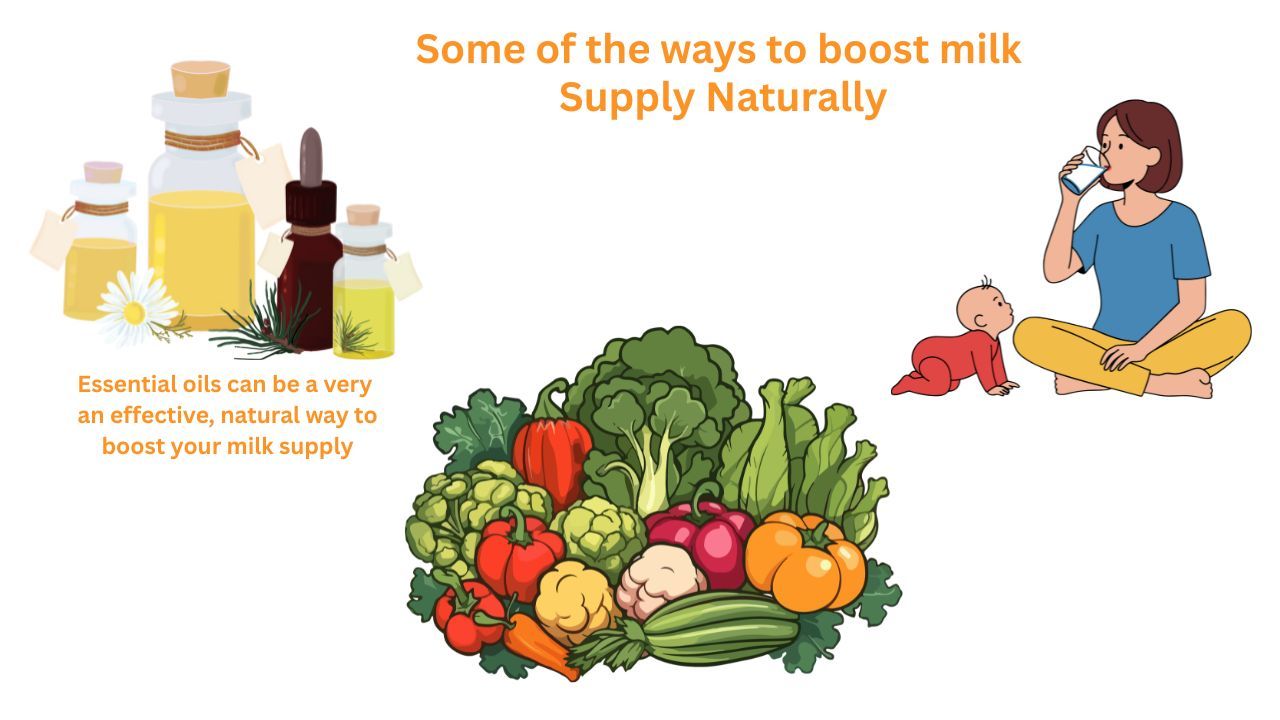
- Peppermint (pudina) - occasional use is fine, avoid large quantities
- Sage (salvia) - avoid completely
- Cabbage leaves - used to DRY up supply, avoid
- Alcohol - wait 2-3 hours after drinking before feeding
- Smoking - reduces supply and affects milk quality
- Birth control pills - some types reduce supply, ask your doctor
What Not to Give the Baby
Under 6 months a breastfed baby needs no other food or drink, apart from formula if your doctor has specifically advised it. (Vitamin D drops your pediatrician has prescribed are a supplement, not a feed: keep giving those.)
- No water or sugar water. It fills a very small stomach, displaces milk, and can be dangerous for a newborn.
- No honey before 1 year, in any form, because of the risk of infant botulism.
- No ghutti or janam ghutti, and no gripe water.
- No cow, buffalo or packet top milk before 1 year.
- Never dilute formula to make the tin last longer. Watered-down formula can cause a dangerous salt and water imbalance. If cost is the problem, say so to your doctor: that is a medical problem to solve, not something to manage quietly at home.
If elders at home are pushing top-feeds during jaapa, you do not have to win an argument. A line that usually works: “Doctor ne kaha hai abhi sirf maa ka doodh, aur doctor hi baby ka wazan check kar rahe hain.” (The doctor has said only breast milk for now, and the doctor is the one tracking the baby’s weight.) Putting the pediatrician in the middle takes the pressure off you. And if someone genuinely believes the baby is not getting enough, the right response is a weight check, not a bottle of ghutti.
When Will I See Results?
- Power pumping: 2-3 days
- Galactagogues: 3-5 days
- Increased feeding frequency: 1-2 days
Important: If you’ve tried these methods for 1-2 weeks with no improvement, consult a lactation specialist or your pediatrician. Sometimes underlying issues (thyroid, retained placenta, PCOS) need medical attention.
Do not wait out that period if your baby is the one showing signs. Get seen the same day if your baby is not gaining weight or is losing weight, has fewer than 6 wet diapers a day after day 4, is very sleepy or hard to wake for feeds, or is feeding weakly. In those situations the answer is not more time, it is an assessment and a feeding plan.
Two of Those Causes Need a Doctor, Not a Lactation Plan
Thyroid problems and PCOS are background history your doctor should know about. Retained placenta is not background at all, and there is one more cause that list leaves out entirely.
- See your obstetrician the same day if low milk comes together with heavy or increasing bleeding, clots, foul-smelling discharge, fever or lower abdominal pain. Retained placental tissue can cause serious bleeding and infection.
- Tell your doctor specifically if you had heavy bleeding at delivery and your milk never came in at all, and especially if you also have unusual tiredness, dizziness, feeling cold, or your periods have not returned. That combination can point to Sheehan’s syndrome, a treatable pituitary problem in which failure of the milk to come in is often the very first sign, and which is frequently missed for years in India. It needs blood tests (thyroid, cortisol, prolactin), not a galactagogue.
If Your Baby Needs Supplementing, That Is Not a Failure
Avoid casual or routine formula top-ups, because they reduce the demand signal and can lower supply. But if your doctor advises supplementing for weight loss, dehydration or jaundice, feed your baby: an under-fed newborn must be fed while the supply problem is being fixed. The order of preference is your own expressed milk first, then formula if that is not enough. When you supplement, express or pump at each feed so your breasts still get the “make more” signal, and ask for a plan to reduce the top-ups as your supply builds.
Sometimes supply cannot be raised quickly enough, or cannot be raised fully at all. Insufficient glandular tissue, previous breast surgery, Sheehan’s syndrome and some hormonal conditions mean a small number of mothers will never make a full supply no matter what they do. That is a medical fact about a body, not a measure of effort or of love.
If your baby needs formula, give it. A fed baby is the first priority, always. Partial breastfeeding, even a small amount, is genuinely worthwhile and worth continuing.
Ask your doctor or lactation consultant to help you decide how much to give and how to protect whatever supply you have. Do not decide the amount by guesswork, and do not stop supplementing on your own because you feel you ought to be managing without it.
Frequently Asked Questions
Q: How do I know if baby is getting enough milk?
A: In the first 2 weeks, weight is the answer. Your baby should be back to birth weight by day 10 to 14, and a loss of more than 10% of birth weight needs same-day medical review. Alongside that, track wet nappies (about one per day of life at first, 6+ from around day 4 to 5) and check that your baby wakes and feeds actively rather than sleeping through feeds. After the newborn period, steady weight gain along the growth curve plus enough wet nappies means your supply is adequate.
Q: Can I take medication to increase milk supply?
A: Be careful here. No medicine anywhere in the world is approved for increasing milk supply. The ones that get used are prescribed off-label, by a doctor, and only after feeding and latch have been properly assessed. The one most often mentioned, domperidone, is a prescription-only medicine that can cause dangerous heart-rhythm disturbances - particularly at higher doses, in mothers with existing heart or electrolyte problems, or alongside certain other drugs. In India it is often handed across the counter without a prescription. Please do not buy it yourself, and do not take a friend’s or a relative’s leftover strip.
Q: My baby is very sleepy and hardly asks for feeds. Isn’t that a good baby?
A: Not necessarily, and in the first weeks it is one of the signs worth taking seriously. A newborn who is not getting enough milk often gets quieter, not louder: sleepy, hard to wake, feeding for only a few minutes before dropping off. If that sounds like your baby, do not wait for the next scheduled visit. Get your baby weighed and examined, and read the danger-sign list at the top of this article.
Q: Is it normal for breasts to feel soft?
A: Yes! After 6-8 weeks, breasts regulate and may feel softer. This doesn’t mean low supply - your body has learned to produce the right amount.
Q: My baby wants to feed constantly. Does that mean low supply?
A: Not necessarily. Cluster feeding (frequent feeding for a few hours) is normal, especially in the evenings and during growth spurts. It’s actually helping BUILD your supply.
Q: Pump se kam doodh aa raha hai - is my supply low?
A: Pump output doesn’t equal actual supply. Many mothers with great supply pump very little. Your baby is much more efficient than a pump.
Q: Can I breastfeed if I’m sick?
A: Usually yes! Your milk will contain antibodies that protect your baby. Check with your doctor about any medications you’re taking.
When to Get Professional Help
Consult a lactation expert if:
- Baby is not gaining weight
- Painful breastfeeding persists beyond 1-2 weeks
- Cracked, bleeding nipples
- You suspect tongue tie or lip tie
- Baby refuses breast consistently
- Signs of mastitis (fever, red painful lump)
Separately from all of the above: if your baby shows any of the danger signs listed at the top of this article, that is a doctor visit today, not a lactation appointment next week.
Where to Find Help in India
IBCLC-certified lactation consultants are still scarce outside the big metros. If you cannot reach one:
- MAA (Mothers’ Absolute Affection) programme counsellors, working through government health facilities
- Lactation Management Centres (CLMCs and LMUs) at some district hospitals and medical colleges. They were set up mainly for sick and preterm babies, so ask whether they see outpatient mothers
- Your ASHA or ANM worker, who can weigh your baby and escalate if something looks wrong
- Online lactation consultations, including Babynama’s, when travel or distance is the barrier
Sources
- WHO / UNICEF, IMCI chart booklet: young-infant jaundice is classified severe and referred urgently for yellow palms and soles at any age, or any jaundice before 24 hours or after 14 days. India’s IMNCI adaptation follows the same classification (National Health Mission).
- Ministry of Health and Family Welfare, National Health Mission: IMNCI chart booklet, https://nhm.gov.in/images/pdf/programmes/child-health/guidelines/imnci_chart_booklet.pdf
- Academy of Breastfeeding Medicine, Clinical Protocol #3: Supplementary Feedings in the Healthy Term Breastfed Neonate (rev. 2017): elimination tracking, meconium still present on day 5 as a warning sign, evaluation at 8-10% weight loss, mean return to birth weight 8.3 days (97.5% by 21 days), and expressed milk first when supplementing. https://www.bfmed.org/assets/DOCUMENTS/PROTOCOLS/3-supplementation-protocol-english.pdf
- Paul IM, Schaefer EW, Miller JR, et al. Weight Change Nomograms for the First Month After Birth. Pediatrics 2016;138(6):e20162625, and www.newbornweight.org (birth weight expected to be regained by 10 to 14 days).
- Khadilkar V, Yadav S, Agrawal KK, et al. Revised IAP Growth Charts for 5-18-year-old Indian children. Indian Pediatrics 2015;52:47-55: the Government of India and IAP have adopted the WHO growth standards for children under 5.
- LactMed (Drugs and Lactation Database), NIH: Fenugreek monograph, https://www.ncbi.nlm.nih.gov/books/NBK501779/ (mixed evidence on supply; caution in diabetes; asthma exacerbation; possible cross-reaction with chickpeas, peanuts and other legumes; maple-syrup odour).
- Korman SH, Cohen E, Preminger A. Pseudo-maple syrup urine disease due to maternal prenatal ingestion of fenugreek. J Paediatr Child Health 2001;37:403-404.
- Gupta M, Shaw B. A double-blind randomized clinical trial for evaluation of galactogogue activity of Asparagus racemosus Willd. Iran J Pharm Res 2011;10(1):167-172 (n=60, prolactin rise; no funding statement).
- Saper RB, Phillips RS, Sehgal A, et al. Lead, mercury, and arsenic in US- and Indian-manufactured Ayurvedic medicines sold via the Internet. JAMA 2008;300(8):915-923 (40 of 193 products, 20.7%, contained detectable metals).
- Ministry of Health and Family Welfare, National Tele Mental Health Programme (Tele-MANAS): 14416 / 1800-891-4416, free, 24x7, 20 languages. https://telemanas.mohfw.gov.in
- Centers for Disease Control and Prevention: Botulism Prevention (“Do not feed honey to a child who is younger than 1 year old”). https://www.cdc.gov/botulism/prevention/index.html
- Bruce RC, Kliegman RM. Hyponatremic seizures secondary to oral water intoxication in infancy: association with commercial bottled drinking water. Pediatrics 1997;100(6):e4 (extra water and over-diluted formula as causes of seizures in infants). WHO / IAP: exclusive breastfeeding to 6 months, no water.
- Sheehan’s Syndrome in India: Clinical Characteristics and Laboratory Evaluation. J Obstet Gynaecol India 2023 (lactation failure in 89.5% of 38 patients; all had postpartum haemorrhage; mean 8.4 years from delivery to diagnosis). https://pmc.ncbi.nlm.nih.gov/articles/PMC10616000/
- Academy of Breastfeeding Medicine, Clinical Protocol #9: Use of Galactogogues (2nd rev., 2018): prescription galactogogues are off-label everywhere; domperidone prolongs QTc and has been implicated in ventricular arrhythmias and sudden cardiac death; the FDA has advised against its use to increase milk production. https://www.bfmed.org/assets/DOCUMENTS/PROTOCOLS/9-galactogogues-protocol-english.pdf
- US Food and Drug Administration, information about domperidone (not approved in the US; warning against use in lactating women because of cardiac risk).
- National Health Mission, MAA (Mothers’ Absolute Affection) programme for breastfeeding promotion and counselling, and Lactation Management Centres. https://nhm.gov.in/index1.php?lang=1&level=3&sublinkid=1450&lid=799
This article was reviewed by the Babynama Medical Team. Last updated: August 2026.
Need personalized help? Book a lactation consultation with our experts on Babynama.
Need personalized guidance? Book a consultation with our pediatricians or explore our Care Plans for 24/7 expert support!
General information for Indian parents, not a substitute for your pediatrician. In an emergency, call 112 or 108.
Need Expert Breastfeeding Support?
Get personalized guidance from certified lactation consultants.
Explore Breastfeeding Program