What’s Happening This Week
Week 6 is the busiest medical week of the newborn period for both baby and mother.
For the baby: the 6-week vaccine visit is the first major vaccination appointment. Your newborn gets multiple vaccines in one session.
For you: the 6-week postnatal check-up is the standard appointment to review your recovery.
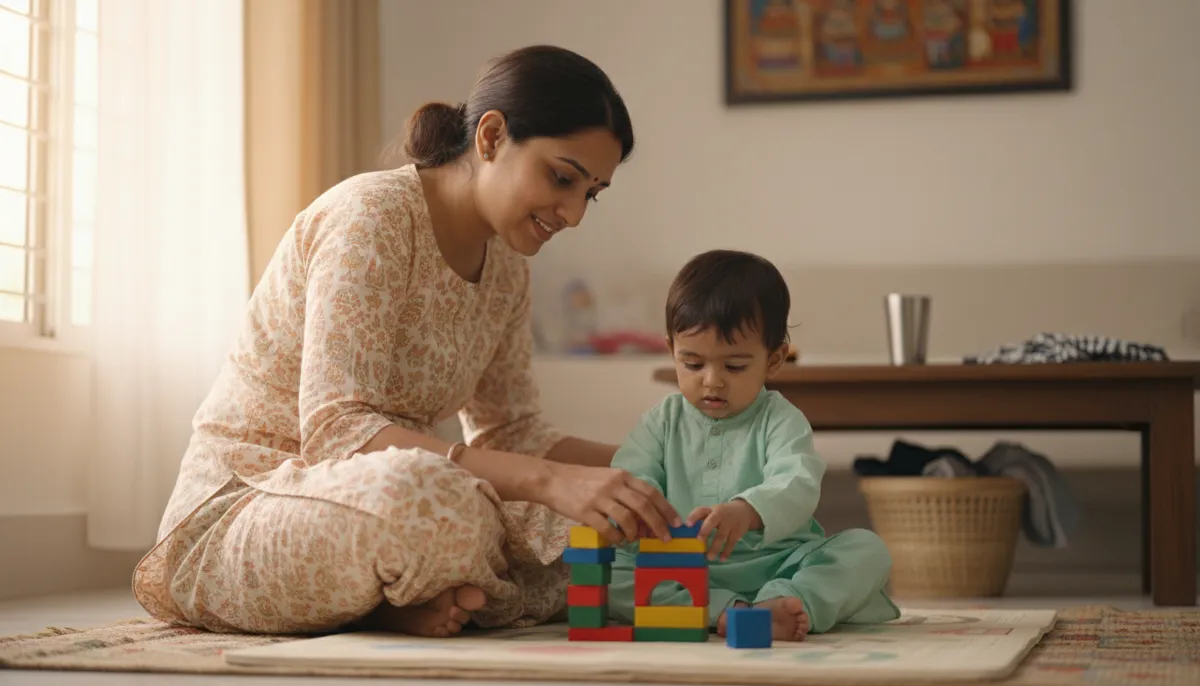
Developmentally, the social smile is now more consistent and deliberate. Your baby may hold a smile for several seconds while looking at your face. Cooing sounds — soft, vowel-based — appear more frequently. Your baby can briefly hold their head up for a few seconds during tummy time. Eye tracking across a wide arc is more fluid.
This is also the peak of the purple crying period for many babies. The witching-hour crying should begin to decline over the coming weeks — though “beginning to decline” may not feel like much relief yet.
Feeding This Week
No significant changes in feeding this week unless something medical requires attention. Feed on demand, watch diaper output, watch weight gain. Breastfed babies typically gain 150–200 g per week through the first 4 months.
Post-vaccine, your baby may feed less for a day or two. This is normal. Keep offering feeds. If your baby refuses multiple feeds in a row and is not consolable, call your pediatrician.
6-Week Vaccinations (IAP Schedule, India)
These vaccines are all due at 6 weeks:
| Vaccine | Protects Against | Route |
|---|---|---|
| DTwP or DTaP (dose 1) | Diphtheria, Tetanus, Pertussis | Injection |
| IPV (dose 1) | Polio | Injection |
| Hib (dose 1) | Haemophilus influenzae type b | Injection |
| PCV (dose 1) | Pneumococcal disease | Injection |
| Rotavirus (dose 1) | Rotavirus diarrhoea | Oral |
| Hepatitis B (dose 2) | Hepatitis B | Injection |
Your baby will likely receive 3–4 injections in one session. Crying at the time of injection is expected and brief. Hold your baby skin-to-skin before and immediately after — it significantly reduces pain response.
Post-Vaccine Care
What to expect:
- Fever: a temperature of 37.5–38.5°C (99.5–101.3°F) within 48 hours of DTwP is common after vaccination. This post-vaccine fever is the one situation where, in an under-3-month baby, you can give paracetamol at home if the baby is otherwise well — you do not need a same-day doctor visit for a mild fever that starts within 48 hours of vaccines. A fever that starts more than 48 hours after the vaccines, or any fever when your baby has not just been vaccinated, must be treated as an emergency (see below).
- Soreness at injection site: red, swollen, or hard lump at the injection site is common. It usually resolves within 1–2 weeks.
- Fussiness: increased crying and unsettled behavior for 24–48 hours is common.
- Drowsiness: some babies sleep more than usual for a day.
Paracetamol is dosed by your baby’s weight, not age: 15 mg/kg per dose, every 4–6 hours, max 4 doses (60 mg/kg) in 24 hours. Check the syrup strength (120 vs 250 mg/5 ml). Not for under-3-months without a doctor — the exception is post-vaccine fever within 48 hours as described above. Confirm the exact mL with your pediatrician.
Do not sponge-bath or apply anything to injection sites for 24 hours. Fever above 39°C (102.2°F) after DTwP is less common and should be reported to your pediatrician.
Mother’s 6-Week Check-Up
The 6-week postnatal visit with your OB/gynecologist covers:
- Wound review: episiotomy or C-section incision — checking healing, removing stitches if not absorbable
- Uterus involution: confirming the uterus has returned to normal size
- Cervical check if needed
- Breastfeeding support: addressing any ongoing issues
- Contraception: if you do not want another pregnancy soon, discuss options. Lactational amenorrhea is not reliable. Options safe for breastfeeding mothers include the progesterone-only pill, copper IUD, or barrier methods. Combined pills reduce milk supply.
- Mental health screening: postpartum depression screening (Edinburgh scale). If you’ve been struggling and haven’t said anything yet — this is the appointment to say it.
Is This Normal?
Multiple simultaneous vaccines. Some parents worry about “overloading” the immune system with several vaccines in one visit. Current evidence does not support this concern — a baby’s immune system handles a very large number of antigens every day, and the antigens in these vaccines are a tiny fraction of that. Combining vaccines at one visit is not shown to increase adverse effects, and it reduces the number of medical visits for your baby.
When to Call the Doctor
⚠️ In a baby under 3 months, ANY fever of 100.4°F (38°C) or higher is a medical emergency — see a doctor the same day, even at night. Do not give paracetamol and wait. Your baby is 6 weeks old, so this rule applies. The one exception is a mild fever that begins within 48 hours of the vaccines, in an otherwise-well baby (see Post-Vaccine Care above).
Also call your doctor for:
- Fever above 39°C (102.2°F) after vaccines
- Fever lasting more than 48 hours after vaccines, or any fever that begins more than 48 hours after vaccines
- Injection site becomes increasingly red, swollen, or hot after 48 hours
- Baby is inconsolable for more than 3 hours after vaccines, or refuses several feeds in a row
- Unusual lethargy, floppiness, or a high-pitched cry
🚨 Call 112 (national emergency) or 108 (ambulance), or go to the nearest hospital, if you see: difficulty/noisy breathing; swelling of face/lips/tongue; widespread hives with vomiting; pale/grey/blue skin; floppiness/unresponsiveness; or a seizure. If an adrenaline auto-injector is prescribed, use it first, then go. Serious allergic reactions to vaccines are rare but need immediate care.
Real Questions from Indian Mothers
These are real questions asked by parents in the Babynama community, answered by our pediatricians.
“What are the things to expect after 6 weeks vaccination? And when to seek medical emergency? Means what are the symptoms that are not normal?”
Fever and pain at the injection site are common. If there is continuous, inconsolable crying, refusal to feed , lethargy , abnormal movements, then visit a pediatrician immediately
“My baby (6 weeks old) is trying to vomit and not being able to sleep comfortably. He even vomited once. He is combo fed.”
- Avoid over feeding - in mixed feeding mostly babies over feed and tend to vomit out or spit up more frequently Hold baby upright (shoulder pe ) and gently pat on back
General information for Indian parents, not a substitute for your pediatrician. In an emergency, call 112 or 108.