Quick Answer: Is This Normal?
Every child develops speech at their own pace, but there are general milestones to watch for. Most babies say their first word around 12 months, but some start earlier and some later. If your bachcha is making progress and engaging with sounds, they’re likely on track. This guide will help you understand what to expect and when to seek help.
Why Speech Development Matters
Language is how children:
- Connect with family and friends
- Express needs and feelings
- Learn about the world
- Develop thinking skills
- Succeed in school Understanding milestones helps you support your child and catch any delays early - when intervention is most effective!
Speech & Hearing Milestones by Age
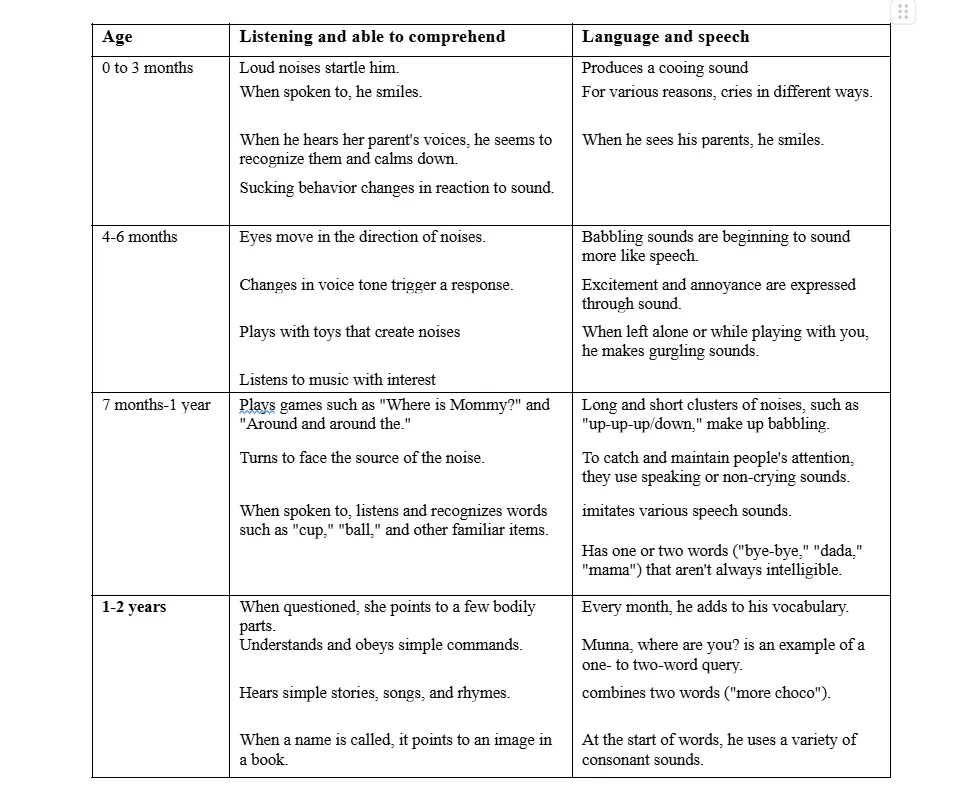
Newborn to 3 Months
Hearing & Understanding:
-
Startles at loud sounds
-
Quiets or smiles when you talk
-
Recognizes your voice
-
Turns toward sounds Communication:
-
Cries differently for different needs
-
Coos and makes pleasure sounds (“ooh”, “aah”)
-
Smiles at people What You Can Do:
-
Talk to baby during daily activities
-
Sing songs and lullabies
-
Respond to coos with words
-
Read simple board books
4 to 6 Months
Hearing & Understanding:
-
Moves eyes toward sounds
-
Responds to changes in your tone
-
Notices toys that make sounds
-
Pays attention to music Communication:
-
Babbles with different sounds (“ba-ba”, “ma-ma”)
-
Giggles and laughs
-
Makes sounds when happy or upset
-
Uses voice to express feelings What You Can Do:
-
Imitate baby’s sounds back to them
-
Play peek-a-boo (respond to coos)
-
Name objects as you show them
-
Sing action songs
7 to 12 Months
Hearing & Understanding:
-
Turns to look when you call their name
-
Understands “no” and “bye-bye”
-
Recognizes common words like “mama”, “papa”, “doodh”
-
Follows simple instructions with gestures Communication:
-
Babbles in longer strings (“baba-mama-dada”)
-
Uses gestures (pointing, waving)
-
Tries to imitate words
-
Says first word around 12 months (mama, papa, etc.)
-
May have 1-3 words by first birthday What You Can Do:
-
Name everything you see
-
Play naming games
-
Encourage pointing
-
Read picture books daily
1 to 2 Years
Hearing & Understanding:
-
Points to body parts when asked
-
Follows simple instructions (“give me the ball”)
-
Understands simple questions
-
Listens to simple stories Communication:
-
Says 10-20 words by 18 months
-
Says 50+ words by 2 years
-
Starts putting 2 words together (“more milk”, “mama come”)
-
Words may not be perfectly clear (normal!)
-
Asks simple questions What You Can Do:
-
Expand on what they say (“Ball?” - “Yes, red ball!”)
-
Read every day - let them point at pictures
-
Limit screen time
-
Talk through daily activities
2 to 3 Years
Hearing & Understanding:
-
Understands two-step instructions (“pick up the toy and give it to papa”)
-
Understands opposites (big/small, hot/cold)
-
Follows simple stories
-
Knows names of familiar things Communication:
-
Says 200-1000 words
-
Uses 2-3 word sentences regularly
-
Can be understood by family most of the time
-
Asks “what” and “where” questions
-
Can say name, age, gender What You Can Do:
-
Have real conversations
-
Ask open-ended questions
-
Read longer stories
-
Sing nursery rhymes together
3 to 4 Years
Hearing & Understanding:
-
Understands “who”, “what”, “where” questions
-
Follows 3-step instructions
-
Understands most of what’s said at home Communication:
-
Speaks in sentences of 4+ words
-
Talks about activities and experiences
-
Strangers can understand most of what they say
-
Uses “I”, “you”, “we” correctly
-
Tells simple stories What You Can Do:
-
Encourage storytelling
-
Play pretend games
-
Explain new words
-
Have daily chat time
4 to 5 Years
Hearing & Understanding:
-
Understands most speech
-
Follows complex instructions
-
Understands stories with beginning/middle/end Communication:
-
Speaks clearly (strangers understand easily)
-
Uses complex sentences
-
Can describe how to do things
-
Tells longer stories
-
Uses future tense (“I will go”) What You Can Do:
-
Discuss events and feelings
-
Play word games
-
Encourage explaining ideas
-
Prepare for school learning
When to Worry (Red Flags)
See a specialist if your child:
| Age | Warning Signs |
|---|---|
| 6 months | No babbling, doesn’t respond to sounds |
| 12 months | No words, doesn’t use gestures (wave/point) |
| 18 months | Fewer than 10 words, doesn’t understand simple requests |
| 2 years | Fewer than 50 words, no 2-word combinations |
| 3 years | Speech very unclear, can’t form sentences |
| Any age | Loses skills they previously had |
Also consult if:
- You suspect hearing problems
- Child doesn’t make eye contact
- Child doesn’t respond to their name
- Speech is significantly different from peers
- You have any concerns!
Boosting Speech Development
Everyday Strategies:
-
Talk, talk, talk: Narrate your day
-
Listen and respond: Give full attention when child speaks
-
Expand language: Add words to what they say
-
Read daily: Even 10 minutes helps!
-
Limit screens: Real interaction beats TV
-
Use both languages: If bilingual, use both confidently
-
Sing songs: Music builds language Indian Language Tips:
-
Speaking Hindi/regional language at home is GREAT
-
Bilingual children may mix languages (normal!)
-
May take slightly longer to hit milestones (still normal!)
-
Both languages develop together
Remember: milestones have wide ranges. Focus on your child’s own progress, not comparison with other children.
FAQs
Q: My 18-month-old only says 5 words. Should I worry?
A: It depends on other factors. Is she understanding well? Using gestures? Making progress? If she understands language and communicates through pointing/gestures, many children catch up. If you’re concerned, a speech evaluation provides peace of mind and early help if needed.
Q: Will screen time delay my child’s speech?
A: Excessive screen time (especially under 2) is linked to speech delays. Interactive screen time (video calling grandparents) is better than passive watching. Real human interaction is best for language development. Limit to 1 hour/day after age 2.
Q: My toddler mixes Hindi and English words. Is this a problem?
A: Not at all! This is called “code-switching” and is typical for bilingual children. It shows they’re learning both languages. They’ll sort it out as they grow. Keep using both languages naturally.
Q: Should I correct my toddler’s pronunciation?
A: Don’t explicitly correct (“No, say it right!”). Instead, model correct speech by repeating correctly: Child: “Look, goggy!” You: “Yes, that’s a doggy!” This teaches without discouraging.
Q: My child started talking then stopped. What’s happening?
A: Some regression is normal during developmental leaps or stress. However, significant loss of language skills needs immediate evaluation. This is a red flag that warrants a pediatrician visit.
This article was reviewed by Babynama Pediatricians.
A note on red flags: If your child suddenly loses speech or other skills they previously had, see your pediatrician promptly. For any medical emergency, call 112 (national emergency) or 108 (ambulance) or go to your nearest hospital.
This article is for general educational purposes and reflects guidance commonly followed in India (IAP). It is not a substitute for an in-person evaluation. Milestones are ranges, not fixed deadlines — if you have any concern about your child’s hearing, speech, or development, consult your pediatrician, who may refer you to an audiologist or speech-language therapist.
Need personalized guidance? Book a consultation with our pediatricians or explore our Care Plans for 24/7 expert support!
Continue with this topic
A useful next step
Browse child-development articlesExplore milestones, movement, speech, behaviour and learning across childhood.Have a question about your little one?
Join our free community for live Q&A with MD pediatricians — no cost to join.
Join the free community