Quick Answer
If your baby seems “floppy” or has low muscle tone, early intervention makes a BIG difference! Hypotonia (low muscle tone) is not a disease itself but a sign of an underlying condition. Many babies with hypotonia improve significantly with therapy. Don’t panic, but do get evaluated - early diagnosis and treatment lead to the best outcomes.
What Is Hypotonia? (Floppy Baby Samjhein)
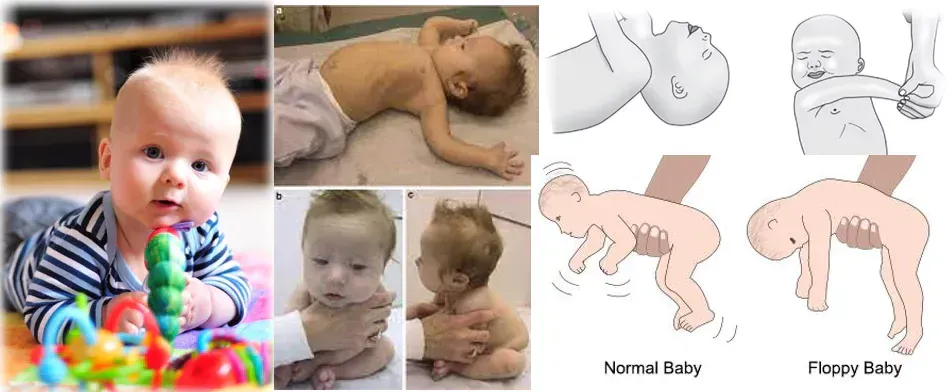
Hypotonia means low muscle tone - baby feels “floppy” when held.
What it looks like:
- Baby feels like a “rag doll” when picked up
- Head flops, doesn’t hold up
- Arms and legs seem loose
- Difficulty sitting, even with support
- May slip through your hands when held Important distinction:
| Hypotonia (Low Tone) | Muscle Weakness |
|---|---|
| Muscles are relaxed/“floppy” | Muscles are weak |
| Baby feels loose when held | Baby can’t generate force |
| May OR may not have weakness too | Can have normal tone |
Many babies with hypotonia have both low tone AND weakness.
Signs and Symptoms (Lakshan)
In Newborns (0-3 months)
- Can’t hold head up at all
- Feels very floppy when held
- Arms and legs straight at sides (no flexion)
- Weak cry
- Difficulty feeding/sucking
- Very little movement
In Infants (3-6 months)
- Still can’t hold head up
- Slips through hands when lifted
- No attempt to reach for things
- Delayed rolling over
In Older Babies (6-12 months)
- Can’t sit without support
- Not crawling or attempting to crawl
- Delayed milestones overall
- May have feeding difficulties
What Causes Hypotonia?
Hypotonia is a SYMPTOM, not a disease. Causes include:
Central Nervous System Causes
- Cerebral palsy
- Brain injury (before, during, or after birth)
- Genetic conditions (Down syndrome, Prader-Willi)
- Brain malformations
Nerve and Muscle Causes
- Spinal muscular atrophy (SMA)
- Muscular dystrophies
- Nerve disorders
Other Causes
- Premature birth (often temporary)
- Hypothyroidism
- Infections
- Some are “benign” with no identifiable cause Benign congenital hypotonia: Some babies have low tone with no serious cause and improve over time.
When to Worry (Red Flags)
🚨 Emergency — call 112 (national emergency) or 108 (ambulance) / go to the nearest hospital if:
- Difficulty breathing
- Blue color (lips, face, tongue)
- No movement at all
- Limpness with poor feeding and no response
See a doctor URGENTLY (same day) if:
- Baby very floppy from birth
- Difficulty swallowing
- Getting worse
Schedule evaluation if:
- Baby not holding head up by 4 months
- Very floppy compared to other babies
- Delayed motor milestones
- Difficulty feeding
- Weak cry
- Arms and legs always extended (not flexed)
Diagnosis (Jaanch)
Doctor will check:
- Physical examination
- Reflexes
- Motor skills
- Feeding ability
- Family history Tests may include:
| Test | What It Checks |
|---|---|
| Blood tests | Thyroid, genetic markers, muscle enzymes |
| MRI/CT brain | Brain structure |
| Genetic testing | Chromosomal abnormalities |
| EMG | Nerve and muscle function |
| Muscle biopsy | Muscle tissue (sometimes) |
Treatment Options (Ilaaj)
Treatment depends on cause, but therapy helps almost all babies:
Physical Therapy (Physiotherapy)
- Improves muscle strength
- Helps motor skill development
- Teaches movement patterns
- Parents learn exercises to do at home
- Often most important treatment!
Occupational Therapy
- Fine motor skills
- Feeding skills
- Daily activities
- Sensory processing
Speech Therapy
- Feeding difficulties
- Swallowing problems
- Later: speech development
Nutritional Support
- Feeding tubes if needed
- High-calorie diet for some conditions
- Monitoring growth
Medical Treatment
- Depends on underlying cause
- Some genetic conditions have specific treatments
- Hypothyroidism treated with thyroid hormone
What You Can Do (Ghar Pe Kya Karein)
Daily Care
- Tummy time - Even if baby doesn’t like it, short sessions help
- Supported sitting - Build trunk strength
- Exercises from therapist - Do these daily!
- Proper positioning - Follow therapist guidance
Feeding Tips
- Upright position for feeding
- Frequent breaks during feeds
- May need special bottles/nipples
- Watch for signs of aspiration
Handling Tips
- Support head and neck always
- Hold close to body
- Be gentle but engage baby
- Talk and stimulate during activities
Sleep Considerations
- Safe sleep position (back)
- Monitor for breathing issues
- Some babies sleep a lot (neend zyada)
- Some have disrupted sleep
Prognosis (Outlook)
Depends on cause:
| Cause | Outlook |
|---|---|
| Premature birth | Often improves significantly |
| Benign hypotonia | Usually catches up |
| Down syndrome | Improves with therapy |
| Cerebral palsy | Variable - therapy helps |
| Genetic muscle conditions | Depends on specific condition |
Key points:
- Early intervention WORKS
- Many children improve significantly
- Therapy makes a real difference
- Some children with mild hypotonia have no lasting issues
Frequently Asked Questions
Q: Mera baby bahut dheela lagta hai. Kya normal hai?
A: Some variation in muscle tone is normal, but if baby feels consistently “floppy,” can’t hold head up at appropriate age, or has delayed milestones, get evaluated. Don’t wait - early intervention makes a difference. Your pediatrician can assess if tone is within normal range or needs further testing.
Q: Hypotonia theek ho sakta hai?
A: It depends on the cause. Babies with benign hypotonia or prematurity-related low tone often improve significantly. Even in conditions that can’t be “cured,” therapy helps babies reach their best potential. Many children with hypotonia live full, active lives. Early and consistent therapy is key.
Q: Physical therapy kitni baar karwani chahiye?
A: This depends on severity and your baby’s needs. Typically: initially 2-3 times per week with therapist, plus daily exercises at home. As baby improves, frequency may decrease. The home exercises you do daily are as important as therapy sessions!
Q: Kya hypotonia wale bachche normal school ja sakte hain?
A: Many children with hypotonia attend regular school! Outcome depends on cause and severity. Children with mild hypotonia or benign congenital hypotonia often have no limitations. Those with underlying conditions may need support. Early intervention improves school readiness.
Q: Down syndrome aur hypotonia ka connection kya hai?
A: Most babies with Down syndrome have hypotonia - it’s a very common feature. But hypotonia does NOT mean your baby has Down syndrome! Many other conditions and sometimes no identifiable cause can result in hypotonia. Your doctor will do appropriate testing to determine the cause.
This article was reviewed by Babynama Pediatricians. Last updated: January 2025
Concerned about your baby’s muscle tone or development? Babynama’s pediatricians can help evaluate milestones and guide you on next steps. Chat with us on WhatsApp!
Need personalized guidance? Book a consultation with our pediatricians or explore our Care Plans for 24/7 expert support!
General information for Indian parents, not a substitute for your pediatrician. In an emergency, call 112 or 108.
Continue with this topic
A useful next step
Browse child-development articlesExplore milestones, movement, speech, behaviour and learning across childhood.Have a question about your little one?
Join our free community for live Q&A with MD pediatricians — no cost to join.
Join the free community