Quick Answer
If your child understands language well but struggles to speak clearly despite trying hard, they may have Childhood Apraxia of Speech (CAS). The good news is that with early intervention and consistent speech therapy, most children with CAS make significant progress! CAS is a motor planning disorder - your child’s brain has difficulty coordinating the movements needed for speech. It’s not about intelligence or understanding - children with CAS are often very bright.
What is Childhood Apraxia of Speech (CAS)?
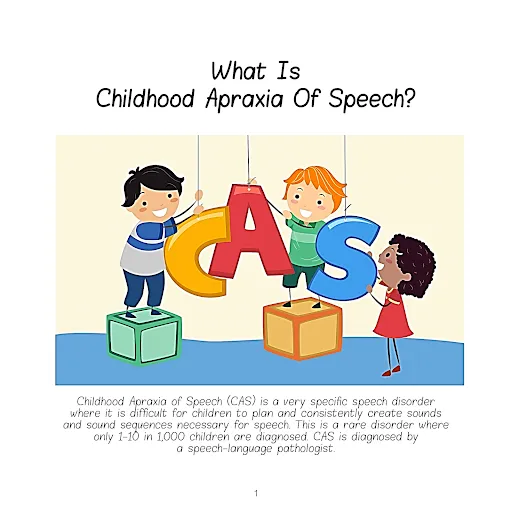
CAS is a neurological speech disorder where the brain has trouble planning and coordinating the muscle movements needed to produce speech sounds, syllables, and words.
Key Points to Understand:
- It’s NOT a muscle weakness problem
- It’s NOT a hearing problem
- It’s NOT a language comprehension problem
- It IS a motor planning/coordination issue
- Your child KNOWS what they want to say but struggles to make mouth movements correctly Think of it like this: Your child’s brain is like a conductor trying to direct an orchestra - it knows the music but has trouble getting the instruments (mouth, lips, tongue, jaw) to play together smoothly.
CAS vs. Regular Speech Delay
| Feature | CAS | Typical Speech Delay |
|---|---|---|
| Understanding language | Good | May be delayed |
| Consistency of errors | Inconsistent - same word sounds different each time | Consistent errors |
| Difficulty with longer words | Much harder than short words | Proportional difficulty |
| Imitation ability | Hard to imitate sounds/words | Can usually imitate |
| Groping for sounds | Visible struggle to form sounds | Less struggle |
| Progress with practice | Slower, needs intensive therapy | Faster with practice |
Signs and Symptoms by Age
In Babies (0-12 months):
-
Limited babbling or late onset of babbling
-
Few consonant sounds
-
Delayed first words
-
May be a quiet baby In Toddlers (1-3 years):
-
Very limited vocabulary for age
-
Loss of words they previously used
-
Difficulty putting sounds together
-
More gestures than words to communicate
-
Words sound different each time they try
-
Frustration when trying to speak
-
Simplified word patterns (e.g., “ba” for “ball” and “baby”) In Preschoolers (3-5 years):
-
Unclear speech that’s hard for others to understand
-
Difficulty saying longer phrases/sentences
-
Obvious struggle to coordinate mouth movements
-
Correct sounds in isolation but errors in words
-
May use shorter sentences to avoid difficult words
-
Stress or emphasis on wrong syllables
-
Voice may sound monotone or robotic
What Causes CAS?
The exact cause is often unknown, but may include:
Possible Factors:
-
Genetic factors (may run in families)
-
Brain development differences
-
Neurological conditions
-
Syndromes (Down syndrome, galactosemia)
-
Stroke or brain injury (rare) Risk Factors in Indian Context:
-
Family history of speech/language disorders
-
Premature birth or low birth weight
-
Developmental delays in other areas
-
Some genetic syndromes Important: In most cases, parents did nothing to cause CAS. It’s not related to parenting style or language exposure.
Diagnosis
CAS is diagnosed by a speech-language pathologist (SLP) through:
Evaluation Includes:
-
Observation of speech and oral movements
-
Testing ability to repeat sounds, words, sentences
-
Checking for inconsistent errors
-
Assessing prosody (rhythm, stress of speech)
-
Ruling out other conditions When to Seek Evaluation:
-
No babbling by 12 months
-
No words by 16-18 months
-
Very limited speech by 24 months
-
Speech that’s very hard to understand by 3 years
-
Obvious struggle to produce sounds
-
Loss of previously learned words
Treatment Options
Speech Therapy - The Primary Treatment:
-
Requires intensive, frequent sessions (3-5 times/week initially)
-
Focus on motor planning and practice
-
Uses multisensory cues (visual, touch, sound)
-
Repetitive practice of sounds and movements
-
Gradual progression from simple to complex Effective Therapy Approaches:
-
PROMPT therapy (tactile cues)
-
DTTC (Dynamic Temporal and Tactile Cueing)
-
ReST (Rapid Syllable Transition Treatment)
-
Melodic Intonation Therapy
-
Integral Stimulation approach Augmentative Communication (if needed):
-
Picture boards
-
Sign language alongside speech
-
Speech-generating devices/apps
-
Used to reduce frustration while working on speech
What You Can Do at Home
Daily Practice (as guided by SLP):
-
Follow therapist’s home practice plan
-
Create structured practice times (10-15 min, 2-3x daily)
-
Make practice fun - use games, songs, rewards
-
Focus on quality over quantity
-
Video record to track progress Communication Strategies:
-
Accept all communication attempts (gestures, sounds, words)
-
Model correct pronunciation without forcing correction
-
Give processing time - don’t rush your child
-
Use visual cues when speaking
-
Reduce background noise during conversations
-
Face your child at eye level when speaking Reduce Frustration:
-
Acknowledge their effort (“I can see you’re trying so hard!”)
-
Offer choices instead of open questions
-
Use visual schedules and picture cards
-
Celebrate small victories
-
Don’t pretend to understand when you don’t - gently ask for clarification Finding Therapy in India:
-
Government hospitals with rehabilitation departments
-
Private speech therapy clinics
-
ENT departments often have speech therapists
-
NIMHANS, AIIMS have excellent departments
-
Online therapy options (especially post-COVID)
When to Worry (Red Flags)
Consult a speech-language pathologist if you notice:
- No babbling by 12 months
- No words by 18 months
- Very limited vocabulary at 2 years
- Speech very hard to understand at 3 years
- Obvious groping/struggling to form sounds
- Inconsistent speech errors
- Frustration and behavioral issues due to communication
- Loss of speech skills
- Difference between understanding and speaking ability
Prognosis - Will My Child Improve?
Yes, most children with CAS make significant improvement with:
-
Early identification and intervention
-
Intensive, ongoing speech therapy
-
Consistent home practice
-
Patient, supportive environment Factors Affecting Outcome:
-
Severity of CAS
-
Age at diagnosis
-
Intensity of therapy
-
Presence of other conditions
-
Family support and practice Many children with CAS:
-
Develop functional speech
-
Communicate effectively
-
Succeed academically with support
-
May have mild residual differences in adulthood
FAQs
Q: Mera bachcha samajhta sab hai but bol nahi pata - is this CAS?
A: This could be CAS, especially if your child also shows signs like inconsistent speech errors, difficulty imitating sounds, and visible struggle to form words. Children with CAS typically understand language well but have trouble with the motor planning for speech. Get an evaluation from a speech-language pathologist to confirm.
Q: Is CAS curable?
A: CAS requires ongoing therapy, not a one-time cure. However, with intensive, consistent speech therapy, most children make significant improvement. Some children achieve nearly typical speech, while others may have mild residual differences. The key is early intervention and persistent practice.
Q: How is CAS different from delayed speech?
A: In typical speech delay, children follow the normal pattern of speech development but at a slower pace. In CAS, the pattern is different - children struggle specifically with the motor planning of speech. They often understand language well but can’t coordinate the movements to speak. A speech therapist can differentiate between the two.
Q: Will my child need therapy forever?
A: The duration varies based on severity. Most children need intensive therapy for several years. As they improve, therapy frequency may decrease. Many children with CAS are discharged from therapy by late elementary school, though some may need periodic support for complex speech tasks.
Q: Can screen time cause or worsen CAS?
A: Screen time does NOT cause CAS - it’s a neurological condition. However, excessive screen time can reduce opportunities for speech practice and interaction, which may slow progress. Balance screen time with face-to-face interaction and speech practice.
Q: Should I use sign language if my child has CAS?
A: Using sign language or gestures alongside speech (not instead of speech) can actually HELP! It reduces frustration, provides a communication bridge, and some studies show it may even support speech development. Consult your speech therapist for guidance.
This article was reviewed by Babynama Pediatricians. Last updated: January 2025
Need personalized guidance? Book a consultation with our pediatricians or explore our Care Plans for 24/7 expert support!
Related Tools
General information for Indian parents, not a substitute for your pediatrician. In an emergency, call 112 or 108.
Continue with this topic
A useful next step
Browse child-development articlesExplore milestones, movement, speech, behaviour and learning across childhood.Have a question about your little one?
Join our free community for live Q&A with MD pediatricians — no cost to join.
Join the free community